European Union leaders voiced hope on Friday that Russia would address international concerns about human rights violations in Chechnya and offer a political solution to the conflict once elections were over.
Published:
26 March 2000 y., Sunday
In a draft text of the conclusions of a two-day summit here, the EU leaders said they saw the presidential election on Sunday as an important opportunity for Russia and the EU to develop a "genuinely effective and working strategic partnership." Acting President Vladimir Putin is a strong favourite in Sunday_s presidential election or in a subsequent runoff. The text also expressed hope that Russia, freed from the pressures of an election campaign, would address "the serious concerns of the international community to see a political solution in Chechnya". The 15-nation EU has repeatedly voiced concern at the situation in Chechnya, where Russian forces have been battling separatist fighters for six months. After the elections, Russia would have a chance to meet international concerns over "the disproportionate use of force, the violations of human rights and the failure of the Russian authorities to investigate these fully ... or to give genuine access to international humanitarian agencies in accordance with their own undertakings," the summit text said. The EU leaders instructed Portuguese Prime Minister Antonio Guterres, whose country currently holds the bloc_s rotating presidency, and EU security chief Javier Solana to travel to Moscow as soon as possible after the election. Guterres and Solana would reaffirm to the new Russian president "the EU_s approach to and concerns about a relationship which is so important to both sides," the draft text said.
Šaltinis:
Reuters
Copying, publishing, announcing any information from the News.lt portal without written permission of News.lt editorial office is prohibited.
The most popular articles
 September 6, literacy courses for local residents were formally opened in the UN Representation in Chaghcharan, capital of province of Ghowr.
more »
September 6, literacy courses for local residents were formally opened in the UN Representation in Chaghcharan, capital of province of Ghowr.
more »
 Lithuania’s Minister of Foreign Affairs Vygaudas Ušackas and Italy’s Minister of Foreign Affairs Franco Frattini discussed perspectives of developing a bilateral dialogue, intensifying economic cooperation, etc.
more »
Lithuania’s Minister of Foreign Affairs Vygaudas Ušackas and Italy’s Minister of Foreign Affairs Franco Frattini discussed perspectives of developing a bilateral dialogue, intensifying economic cooperation, etc.
more »
 During the informal meeting of European Union’s foreign ministers on 4-5 September in Stockholm, Lithuania’s Minister of Foreign Affairs Vygaudas Ušackas and his counterparts discussed the issues of Afghanistan, relations with Iran...
more »
During the informal meeting of European Union’s foreign ministers on 4-5 September in Stockholm, Lithuania’s Minister of Foreign Affairs Vygaudas Ušackas and his counterparts discussed the issues of Afghanistan, relations with Iran...
more »
 On 3 September in Vilnius, Lithuania’s Minister of Foreign Affairs V. Ušackas met with Vice-President of the European Commission G. Verheugen, responsible for enterprise and industry, and discussed the most important issues of economy, energy and the implementation of the Treaty of Lisbon.
more »
On 3 September in Vilnius, Lithuania’s Minister of Foreign Affairs V. Ušackas met with Vice-President of the European Commission G. Verheugen, responsible for enterprise and industry, and discussed the most important issues of economy, energy and the implementation of the Treaty of Lisbon.
more »
 On 22 July, the Government approved of the amendments to the Labour Code proposed by the Ministry of Social Security and Labour.
more »
On 22 July, the Government approved of the amendments to the Labour Code proposed by the Ministry of Social Security and Labour.
more »
 Lithuania’s Minister of Foreign Affairs V. Ušackas discussed the problems of Lithuanian carriers while crossing the Russian border with Igor Levitin, Minister of Transport of the Russian Federation and co-chairman of the Lithuanian-Russian intergovernmental commission.
more »
Lithuania’s Minister of Foreign Affairs V. Ušackas discussed the problems of Lithuanian carriers while crossing the Russian border with Igor Levitin, Minister of Transport of the Russian Federation and co-chairman of the Lithuanian-Russian intergovernmental commission.
more »
 Lithuania‘s Minister of Foreign Affairs welcomed the decision of the new NATO Secretary General Anders Fogh Rasmussen to include a joint representative of the Baltic States into a group of experts which is tasked to prepare a new Strategic Concept of NATO.
more »
Lithuania‘s Minister of Foreign Affairs welcomed the decision of the new NATO Secretary General Anders Fogh Rasmussen to include a joint representative of the Baltic States into a group of experts which is tasked to prepare a new Strategic Concept of NATO.
more »
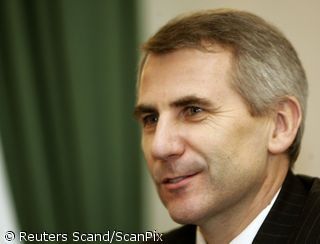 On 3 August, Lithuania’s Minister of Foreign Affairs Vygaudas Ušackas met with Serbia’s Foreign Minister Vuk Jeremić, who was paying a visit to Lithuania.
more »
On 3 August, Lithuania’s Minister of Foreign Affairs Vygaudas Ušackas met with Serbia’s Foreign Minister Vuk Jeremić, who was paying a visit to Lithuania.
more »
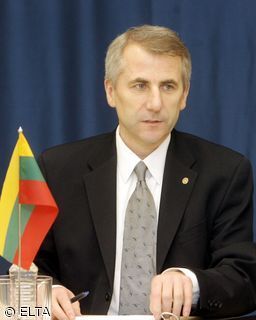 On 30 July, Lithuania’s Minister of Foreign Affairs Vygaudas Ušackas bade farewell to outgoing Ambassador of Belgium to Lithuania Filip Cumps and thanked him for his input into fostering bilateral relations.
more »
On 30 July, Lithuania’s Minister of Foreign Affairs Vygaudas Ušackas bade farewell to outgoing Ambassador of Belgium to Lithuania Filip Cumps and thanked him for his input into fostering bilateral relations.
more »
 On 29 July farewell ceremony with the departing Canadian Defence Attaché for Lithuania Jim Petryk was held in the Ministry of National Defence.
more »
On 29 July farewell ceremony with the departing Canadian Defence Attaché for Lithuania Jim Petryk was held in the Ministry of National Defence.
more »