Warsaw and Berlin are still at odds concerning the key issue of the future constitution of the European Union-the distribution of votes
Published:
3 October 2003 y., Friday
Warsaw and Berlin are still at odds concerning the key issue of the future constitution of the European Union-the distribution of votes.
The heads of both governments met Sept. 22 in Gelsenkirchen at the 6th Polish-German inter-governmental consultations. Prime Minister Leszek Miller and Chancellor Gerhard Schröder did not reach any compromise in their positions concerning the eventual distribution of votes in the EU, which will be entered in the future Constitution Treaty. "When it comes to the voting system, we are still not as close to agreement with each other as is necessary," Schröder said. "I would like to clearly state that Germany has nearly no room to maneuver here, but we need to keep talking."
The current draft of the Constitution Treaty compiled by the European Convention proposes changes in the principles adopted at the summit in Nice in 2000. The changes are disadvantageous to Poland. The Nice system gives Poland 27 votes, a power similar to that of, for example, Germany, which has 29 votes. In the new voting system proposed in the draft, decisions would be made by a simple majority of the number of countries, but the majority would have to represent no less than 60 percent of the EU's population. With this method, Poland's voice would become weaker by a half.
Germany advocates the new system of making decisions and adopting the draft of the Constitution Treaty without amendments. Schröder pointed to the fact that back in Nice, Germany's opinion had been that the principle of double majority made sense and was very democratic. Miller said further negotiations were necessary and the best time for them would be the inter-governmental conference of EU member and candidate countries, which will begin Oct. 4 in Rome.
Šaltinis:
warsawvoice.pl
Copying, publishing, announcing any information from the News.lt portal without written permission of News.lt editorial office is prohibited.
The most popular articles
 Heads of foreign states bid farewell to the late President of the Republic of Lithuania, Algirdas Mykolas Brazauskas.
more »
Heads of foreign states bid farewell to the late President of the Republic of Lithuania, Algirdas Mykolas Brazauskas.
more »
 Today we say farewell to one of the most prominent Lithuanian politicians, a sincere and open person, a man of principle, Algirdas Brazauskas - the first directly elected president of Lithuania after re-independence.
more »
Today we say farewell to one of the most prominent Lithuanian politicians, a sincere and open person, a man of principle, Algirdas Brazauskas - the first directly elected president of Lithuania after re-independence.
more »
 Head of Cabinet of the Secretary General of the Council of the European Union Marek Mora is paying a visit to Lithuania from 30 June to 1 July.
more »
Head of Cabinet of the Secretary General of the Council of the European Union Marek Mora is paying a visit to Lithuania from 30 June to 1 July.
more »
 Lithuania‘s Minister of Foreign Affairs A. Ažubalis says, that continuous implementation of the Treaty of Lisbon, energy security, as well as European Union‘s relations with Eastern Neighbourhood countries and Russia would stay on the list of European policy issues that are the most important to Lithuania in the second half of 2010.
more »
Lithuania‘s Minister of Foreign Affairs A. Ažubalis says, that continuous implementation of the Treaty of Lisbon, energy security, as well as European Union‘s relations with Eastern Neighbourhood countries and Russia would stay on the list of European policy issues that are the most important to Lithuania in the second half of 2010.
more »
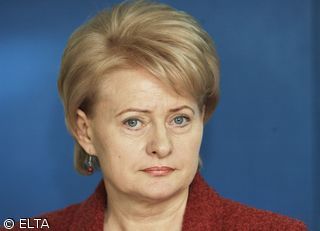 President of the Republic of Lithuania Dalia Grybauskaitė calls the decisions adopted by the European Council strategic and important for Lithuania and for the whole European Union.
more »
President of the Republic of Lithuania Dalia Grybauskaitė calls the decisions adopted by the European Council strategic and important for Lithuania and for the whole European Union.
more »
 On 16 June in Vilnius, Lithuania’s Minister of Foreign Affairs Audronius Ažubalis and Poland’s Minister of National Defence Bogdan Klich discussed successful bilateral cooperation on security and defence matters.
more »
On 16 June in Vilnius, Lithuania’s Minister of Foreign Affairs Audronius Ažubalis and Poland’s Minister of National Defence Bogdan Klich discussed successful bilateral cooperation on security and defence matters.
more »
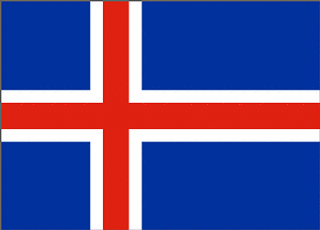 President of the Republic of Lithuania Dalia Grybauskaitė sent congratulations to President Ólafur Ragnar Grímsson of the Republic of Iceland on Iceland's national holiday, the Independence Day.
more »
President of the Republic of Lithuania Dalia Grybauskaitė sent congratulations to President Ólafur Ragnar Grímsson of the Republic of Iceland on Iceland's national holiday, the Independence Day.
more »
 President of the Republic of Lithuania Dalia Grybauskaitė goes on an official visit to the Grand Duchy of Luxembourg.
more »
President of the Republic of Lithuania Dalia Grybauskaitė goes on an official visit to the Grand Duchy of Luxembourg.
more »
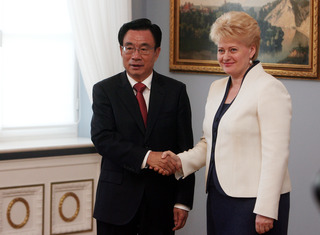 President of the Republic of Lithuania Dalia Grybauskaitė received a high-ranking government official from China, He Guoqiang.
more »
President of the Republic of Lithuania Dalia Grybauskaitė received a high-ranking government official from China, He Guoqiang.
more »
 On the occasion of European Day for Border Guards, the 10th of June, heads of diplomatic missions of the European Union member states in Lithuania visited the Border Guard School in Medininkai.
more »
On the occasion of European Day for Border Guards, the 10th of June, heads of diplomatic missions of the European Union member states in Lithuania visited the Border Guard School in Medininkai.
more »