Warsaw and Berlin are still at odds concerning the key issue of the future constitution of the European Union-the distribution of votes
Published:
3 October 2003 y., Friday
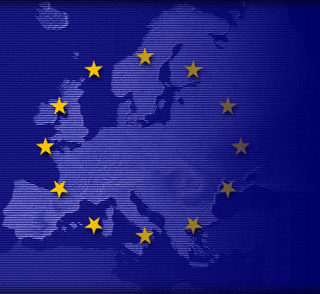
Warsaw and Berlin are still at odds concerning the key issue of the future constitution of the European Union-the distribution of votes.
The heads of both governments met Sept. 22 in Gelsenkirchen at the 6th Polish-German inter-governmental consultations. Prime Minister Leszek Miller and Chancellor Gerhard Schröder did not reach any compromise in their positions concerning the eventual distribution of votes in the EU, which will be entered in the future Constitution Treaty. "When it comes to the voting system, we are still not as close to agreement with each other as is necessary," Schröder said. "I would like to clearly state that Germany has nearly no room to maneuver here, but we need to keep talking."
The current draft of the Constitution Treaty compiled by the European Convention proposes changes in the principles adopted at the summit in Nice in 2000. The changes are disadvantageous to Poland. The Nice system gives Poland 27 votes, a power similar to that of, for example, Germany, which has 29 votes. In the new voting system proposed in the draft, decisions would be made by a simple majority of the number of countries, but the majority would have to represent no less than 60 percent of the EU's population. With this method, Poland's voice would become weaker by a half.
Germany advocates the new system of making decisions and adopting the draft of the Constitution Treaty without amendments. Schröder pointed to the fact that back in Nice, Germany's opinion had been that the principle of double majority made sense and was very democratic. Miller said further negotiations were necessary and the best time for them would be the inter-governmental conference of EU member and candidate countries, which will begin Oct. 4 in Rome.
Šaltinis:
warsawvoice.pl
Copying, publishing, announcing any information from the News.lt portal without written permission of News.lt editorial office is prohibited.
The most popular articles
 On 28 July at the square in front of the Ministry of National Defence the solemn initiation ceremony of the assigning of the Chief of Defence of the Republic of Lithuania was held.
more »
On 28 July at the square in front of the Ministry of National Defence the solemn initiation ceremony of the assigning of the Chief of Defence of the Republic of Lithuania was held.
more »
 On 28 July, Lithuania’s Minister of Foreign Affairs Vygaudas Ušackas met with Minister of Foreign Affairs of Bosnia and Herzegovina Sven Alkalaj, who was paying an official visit to Lithuania.
more »
On 28 July, Lithuania’s Minister of Foreign Affairs Vygaudas Ušackas met with Minister of Foreign Affairs of Bosnia and Herzegovina Sven Alkalaj, who was paying an official visit to Lithuania.
more »
 Lithuanian Minister of National Defence and Estonian Defence Minister by phone discussed readiness of Baltic Battalion to be on duty in NATO Response Force after the information that due to extremely difficult economic situation Latvia will decrease its input into the battalion.
more »
Lithuanian Minister of National Defence and Estonian Defence Minister by phone discussed readiness of Baltic Battalion to be on duty in NATO Response Force after the information that due to extremely difficult economic situation Latvia will decrease its input into the battalion.
more »
 In the evening of 27 July in Brussels at the end of the EU foreign ministers’ meeting and before the EU-Belarus consultations, Lithuania’s Minister of Foreign Affairs V. Ušackas met with Minister of Foreign Affairs of Belarus S. Martynov.
more »
In the evening of 27 July in Brussels at the end of the EU foreign ministers’ meeting and before the EU-Belarus consultations, Lithuania’s Minister of Foreign Affairs V. Ušackas met with Minister of Foreign Affairs of Belarus S. Martynov.
more »
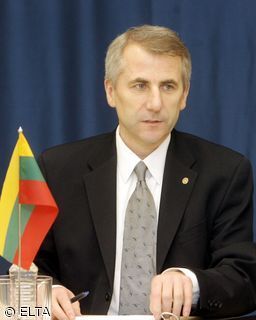 On 27 July in Brussels, Lithuania’s Minister of Foreign Affairs Vygaudas Ušackas and EU Foreign Ministers discussed the situation in Georgia and its neighbourhood.
more »
On 27 July in Brussels, Lithuania’s Minister of Foreign Affairs Vygaudas Ušackas and EU Foreign Ministers discussed the situation in Georgia and its neighbourhood.
more »
 Lithuania’s Minister of Foreign Affairs Vygaudas Ušackas met with Iceland’s Minister for Foreign Affairs Össur Skarphedinsson, Minister of Social Affairs and Social Security Árni Páll Árnason and Chairman of the Parliamentary Committee on Foreign Affairs Árni Thór Sigurdsson.
more »
Lithuania’s Minister of Foreign Affairs Vygaudas Ušackas met with Iceland’s Minister for Foreign Affairs Össur Skarphedinsson, Minister of Social Affairs and Social Security Árni Páll Árnason and Chairman of the Parliamentary Committee on Foreign Affairs Árni Thór Sigurdsson.
more »
 President Dalia Grybauskaitė received the Apostolic Nuncio to Lithuania, Archbishop Luigi Bonazzi.
more »
President Dalia Grybauskaitė received the Apostolic Nuncio to Lithuania, Archbishop Luigi Bonazzi.
more »
 On 23 July in Stockholm, Vice-Minister of Foreign Affairs of Lithuania Asta Skaisgirytė Liauškienė and Swedish Minister for European Affairs Cecilia Malmström discussed priorities of Sweden’s EU Presidency.
more »
On 23 July in Stockholm, Vice-Minister of Foreign Affairs of Lithuania Asta Skaisgirytė Liauškienė and Swedish Minister for European Affairs Cecilia Malmström discussed priorities of Sweden’s EU Presidency.
more »
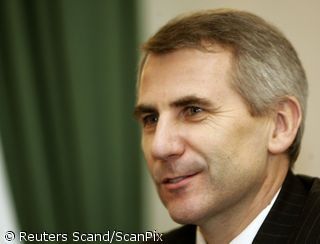 Lithuania’s Acting Minister of Foreign Affairs V. Ušackas had a telephone conversation with Iceland’s Minister for Foreign Affairs Össur Skarphedinsson, during which the Ministers discussed Iceland’s decision to apply for the European Union membership.
more »
Lithuania’s Acting Minister of Foreign Affairs V. Ušackas had a telephone conversation with Iceland’s Minister for Foreign Affairs Össur Skarphedinsson, during which the Ministers discussed Iceland’s decision to apply for the European Union membership.
more »
 Acting in conformity the Constitution of Lithuania and based on the proposal submitted by Prime Minister Andrius Kubilius, President D. Grybauskaitė has approved the Government of the Republic of Lithuania.
more »
Acting in conformity the Constitution of Lithuania and based on the proposal submitted by Prime Minister Andrius Kubilius, President D. Grybauskaitė has approved the Government of the Republic of Lithuania.
more »