Leaders of the world's major industrialized nations, hoping to stem a growing backlash against globalization, pledged Sunday at their annual economic summit to do more to provide schooling, health care and food to the poorest nations.
Published:
24 July 2000 y., Monday
In a communique issued at the conclusion of their three-day summit, the leaders cited "unprecedented economic progress" by many world nations and agreed that more must be done to spread that prosperity to poorer nations. "The 21st century must be a century of prosperity for all," they said.
They said their countries must work harder to relieve the debt burden of developing nations. "We must for our part promote more responsible lending and borrowing practices to ensure that (poor countries) will not again be burdened by unsupportable
debt," the communique said.
German Chancellor Gerhard Schroeder, whose country agreed to restructure $4 billion of Russia's debt, suggested that wealthy nations hold back demands for poorer countries to pay off their loans. "It would be better to put the money in health and education systems in these countries," he told reporters.
The Okinawa meeting was the first "development summit" for the Group of Eight - leaders of the seven richest industrialized nations and Russia, and the last G-8
meeting for President Clinton. Clinton announced that the United States will send $300 million in surplus farm crops to provide school lunches in the developing world.
The eight countries set a goal of universal primary education for all the world's children by 2015, and gender equality in schools by 2005. Currently, 100 million children in developing nations are not in school.
They also vowed to reduce by the year 2010 the number of HIV-infected young people by 25 percent, tuberculosis deaths by 50 percent, and the burden of diseases associated with malaria by 50 percent.
Šaltinis:
AP Online
Copying, publishing, announcing any information from the News.lt portal without written permission of News.lt editorial office is prohibited.
The most popular articles
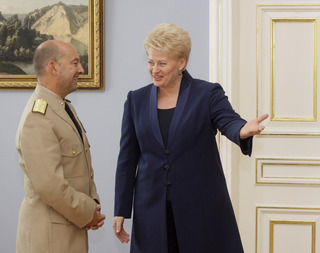 The President of the Republic of Lithuania, Dalia Grybauskaitė, met with the Commander of the US European Command and NATO's Supreme Allied Commander Europe, Admiral James G. Stavridis.
more »
The President of the Republic of Lithuania, Dalia Grybauskaitė, met with the Commander of the US European Command and NATO's Supreme Allied Commander Europe, Admiral James G. Stavridis.
more »
 The President of the Republic of Lithuania, Dalia Grybauskaitė, met with the Prime Minister of Estonia, Andrus Ansip, who is on a visit to Lithuania.
more »
The President of the Republic of Lithuania, Dalia Grybauskaitė, met with the Prime Minister of Estonia, Andrus Ansip, who is on a visit to Lithuania.
more »
 July 12 marks one year since President Dalia Grybauskaitė took office. What has changed in Lithuania over that time?
more »
July 12 marks one year since President Dalia Grybauskaitė took office. What has changed in Lithuania over that time?
more »
 On 8-9 July in Genval, Belgium, Political Director of Lithuania’s Ministry of Foreign Affairs Eitvydas Bajarūnas took part in the consultations of political directors from foreign ministries of 27 European Union member states.
more »
On 8-9 July in Genval, Belgium, Political Director of Lithuania’s Ministry of Foreign Affairs Eitvydas Bajarūnas took part in the consultations of political directors from foreign ministries of 27 European Union member states.
more »
 On 9 July, Lithuania’s Minister of Foreign Affairs Audronius Ažubalis received the outgoing Ambassador of Ukraine Ihor Prokopchuk.
more »
On 9 July, Lithuania’s Minister of Foreign Affairs Audronius Ažubalis received the outgoing Ambassador of Ukraine Ihor Prokopchuk.
more »
 On 7 July in Vilnius, Lithuania’s Minister of Foreign Affairs Audronius Ažubalis and Israel’s Foreign Minister Avigdor Liberman discussed bilateral political, economic and cultural cooperation, as well as possibilities to intensify economic, trade and tourist exchanges.
more »
On 7 July in Vilnius, Lithuania’s Minister of Foreign Affairs Audronius Ažubalis and Israel’s Foreign Minister Avigdor Liberman discussed bilateral political, economic and cultural cooperation, as well as possibilities to intensify economic, trade and tourist exchanges.
more »
 In the statement by U.S. President Barack Obama on the 10th Anniversary of the Community of Democracies that was released on 3 July, the President commended Lithuania for its Presidency of the Community and efforts to focus on the pressing challenges of today.
more »
In the statement by U.S. President Barack Obama on the 10th Anniversary of the Community of Democracies that was released on 3 July, the President commended Lithuania for its Presidency of the Community and efforts to focus on the pressing challenges of today.
more »
 "You offer us yet another opportunity to put ourselves and our civic mind to the test of time. Your example makes us raise our standards higher and higher," President of the Republic of Lithuania Dalia Grybauskaitė said at the ceremony of presenting state awards.
more »
"You offer us yet another opportunity to put ourselves and our civic mind to the test of time. Your example makes us raise our standards higher and higher," President of the Republic of Lithuania Dalia Grybauskaitė said at the ceremony of presenting state awards.
more »
 President Dalia Grybauskaitė offered personal congratulations by phone to President-elect Bronisław Komorowski on his victory in Poland's presidential elections.
more »
President Dalia Grybauskaitė offered personal congratulations by phone to President-elect Bronisław Komorowski on his victory in Poland's presidential elections.
more »
 Foreign states and international organizations extend condolences to Lithuania on the passing of President Algirdas Mykolas Brazauskas
more »
Foreign states and international organizations extend condolences to Lithuania on the passing of President Algirdas Mykolas Brazauskas
more »