Moore's Law, as chip manufacturers generally refer to it today, is coming to an end, according to a recent research paper
Published:
2 December 2003 y., Tuesday
Granted, that end likely won't come for about two decades, but Intel researchers have recently published a paper theorizing that chipmakers will hit a wall when it comes to shrinking the size of transistors, one of the chief methods for making chips that are smaller, more powerful and cheaper than their predecessors.
Manufacturers will be able to produce chips on the 16-nanometer manufacturing process, expected by conservative estimates to arrive in 2018, and maybe one or two manufacturing processes after that, but that's it.
"This looks like a fundamental limit," said Paolo Gargini, director of technology strategy at Intel and an Intel fellow. The paper, titled "Limits to Binary Logic Switch Scaling--A Gedanken Model," was written by four authors and was published in the Proceedings of the IEEE (Institute of Electrical and Electronics Engineers) in November.
Although it's not unusual for researchers to theorize about the end of transistor scaling, it's an unusual statement for researchers from Intel, and it underscores the difficulties chip designers currently face. The size, energy consumption and performance requirements of today's computers are forcing semiconductor makers to completely rethink how they design their products and are prompting many to pool design with research and development.
Resolving these issues is a major goal for the entire industry. Under Moore's Law, chipmakers can double the number of transistors on a given chip every two years, an exponential growth pattern that has allowed computers to get both cheaper and more powerful at the same time.
Šaltinis:
news.com.com
Copying, publishing, announcing any information from the News.lt portal without written permission of News.lt editorial office is prohibited.
The most popular articles
 BMW recently highlighted an electric scooter, currently still in the concept phase, targeted at green-leaning commuters.
more »
BMW recently highlighted an electric scooter, currently still in the concept phase, targeted at green-leaning commuters.
more »
 "I'm excited about where these findings could take us in terms of eventually developing a new type of analgesic for people who suffer from chronic pain."
more »
"I'm excited about where these findings could take us in terms of eventually developing a new type of analgesic for people who suffer from chronic pain."
more »
 The Anonymous hackers now have names, at least in Italy. A series of dawn searches this morning concluded investigations by IT police, led by Antonio Abruzzese, into coordinated computer attacks by the group over the past few months.
more »
The Anonymous hackers now have names, at least in Italy. A series of dawn searches this morning concluded investigations by IT police, led by Antonio Abruzzese, into coordinated computer attacks by the group over the past few months.
more »
 He world's first flying car has been authorized to use roads while flying in the air.
more »
He world's first flying car has been authorized to use roads while flying in the air.
more »
 This is the adjustable-height desk that pairs with a semi-recumbent elliptical trainer to let users exercise while on the job.
more »
This is the adjustable-height desk that pairs with a semi-recumbent elliptical trainer to let users exercise while on the job.
more »
 Scientists at the Chinese University of Hong Kong have developed an autonomous, caterpillar-inspired robot, designed to climb trees and spot danger to forests via a built-in camera.
more »
Scientists at the Chinese University of Hong Kong have developed an autonomous, caterpillar-inspired robot, designed to climb trees and spot danger to forests via a built-in camera.
more »
 Nuclear officials confident over safety levels of flooded nuclear power plant.
more »
Nuclear officials confident over safety levels of flooded nuclear power plant.
more »
 A 19 year old computer hacker in London has been released on bail after being charged with attacking government websites.
more »
A 19 year old computer hacker in London has been released on bail after being charged with attacking government websites.
more »
 Greek Communists rally at historical monument in Athens to protest new round of austerity measures
more »
Greek Communists rally at historical monument in Athens to protest new round of austerity measures
more »
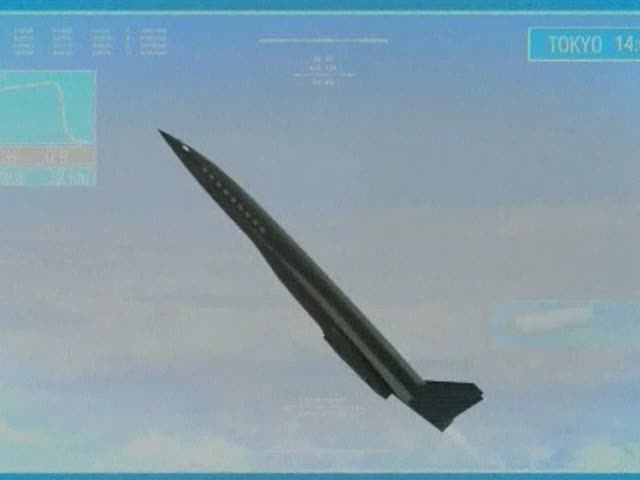 Imagine flying from Tokyo to Paris in less than two and a half hours, without having to burn tons of fossil fuel. One day it might be possible. The concept of zero-emissions, supersonic flight is being explored by European aircraft maker, EADS.
more »
Imagine flying from Tokyo to Paris in less than two and a half hours, without having to burn tons of fossil fuel. One day it might be possible. The concept of zero-emissions, supersonic flight is being explored by European aircraft maker, EADS.
more »