Moore's Law, as chip manufacturers generally refer to it today, is coming to an end, according to a recent research paper
Published:
2 December 2003 y., Tuesday
Granted, that end likely won't come for about two decades, but Intel researchers have recently published a paper theorizing that chipmakers will hit a wall when it comes to shrinking the size of transistors, one of the chief methods for making chips that are smaller, more powerful and cheaper than their predecessors.
Manufacturers will be able to produce chips on the 16-nanometer manufacturing process, expected by conservative estimates to arrive in 2018, and maybe one or two manufacturing processes after that, but that's it.
"This looks like a fundamental limit," said Paolo Gargini, director of technology strategy at Intel and an Intel fellow. The paper, titled "Limits to Binary Logic Switch Scaling--A Gedanken Model," was written by four authors and was published in the Proceedings of the IEEE (Institute of Electrical and Electronics Engineers) in November.
Although it's not unusual for researchers to theorize about the end of transistor scaling, it's an unusual statement for researchers from Intel, and it underscores the difficulties chip designers currently face. The size, energy consumption and performance requirements of today's computers are forcing semiconductor makers to completely rethink how they design their products and are prompting many to pool design with research and development.
Resolving these issues is a major goal for the entire industry. Under Moore's Law, chipmakers can double the number of transistors on a given chip every two years, an exponential growth pattern that has allowed computers to get both cheaper and more powerful at the same time.
Šaltinis:
news.com.com
Copying, publishing, announcing any information from the News.lt portal without written permission of News.lt editorial office is prohibited.
The most popular articles
The whale shark is the largest living fish species and is usually found in tropical and warm oceans. This gentle giant is not dangerous to humans but demand for its internal organs is putting it in grave danger.
more »
 Land shortages in China and environmental concerns have inspired innovative alternatives at the Asia Funeral Expo in Hong Kong.
more »
Land shortages in China and environmental concerns have inspired innovative alternatives at the Asia Funeral Expo in Hong Kong.
more »
 Britain's Queen Elizabeth delivers landmark speech of reconciliation during visit to Ireland but stops short of apology.
more »
Britain's Queen Elizabeth delivers landmark speech of reconciliation during visit to Ireland but stops short of apology.
more »
 French climber Alain Robert, known as "Spiderman" scales Turkey's tallest building.
more »
French climber Alain Robert, known as "Spiderman" scales Turkey's tallest building.
more »
 The growth of a tree takes place so slowly that, in real time, it's impossible to observe. Six years ago plant-lover and British film-maker Neil Bromhall decided to speed up the process with time-lapse photography...
more »
The growth of a tree takes place so slowly that, in real time, it's impossible to observe. Six years ago plant-lover and British film-maker Neil Bromhall decided to speed up the process with time-lapse photography...
more »
 Chinese artist Wang Jiang makes portraits of famous faces including U.S. President Barack Obama and Osama bin Laden from nothing but paper torn by hand.
more »
Chinese artist Wang Jiang makes portraits of famous faces including U.S. President Barack Obama and Osama bin Laden from nothing but paper torn by hand.
more »
 Residents of the southern Spanish town of Lorca stay in makeshift camps and shelters after an earthquake hits the town, destroying buildings and killing at least eight.
more »
Residents of the southern Spanish town of Lorca stay in makeshift camps and shelters after an earthquake hits the town, destroying buildings and killing at least eight.
more »
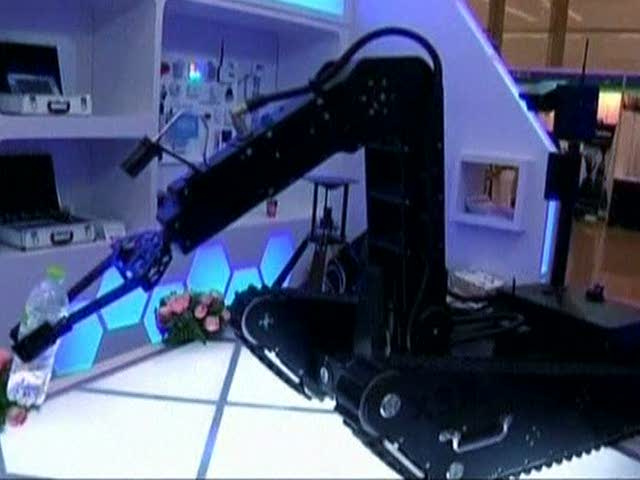 The latest technological development in robots is the main focus of the Shanghai International Conference on Robotics and Automation in China.
more »
The latest technological development in robots is the main focus of the Shanghai International Conference on Robotics and Automation in China.
more »
 A rare earthquake rocked Lorca, an ancient town in southeastern Spain, on Wednesday causing houses to collapse, damaging historic churches and public buildings and killing at least 10 people.
more »
A rare earthquake rocked Lorca, an ancient town in southeastern Spain, on Wednesday causing houses to collapse, damaging historic churches and public buildings and killing at least 10 people.
more »
 A small factory in New York's Brooklyn is doing its best to keep the dying art of making vinyl records.
more »
A small factory in New York's Brooklyn is doing its best to keep the dying art of making vinyl records.
more »