Moore's Law, as chip manufacturers generally refer to it today, is coming to an end, according to a recent research paper
Published:
2 December 2003 y., Tuesday
Granted, that end likely won't come for about two decades, but Intel researchers have recently published a paper theorizing that chipmakers will hit a wall when it comes to shrinking the size of transistors, one of the chief methods for making chips that are smaller, more powerful and cheaper than their predecessors.
Manufacturers will be able to produce chips on the 16-nanometer manufacturing process, expected by conservative estimates to arrive in 2018, and maybe one or two manufacturing processes after that, but that's it.
"This looks like a fundamental limit," said Paolo Gargini, director of technology strategy at Intel and an Intel fellow. The paper, titled "Limits to Binary Logic Switch Scaling--A Gedanken Model," was written by four authors and was published in the Proceedings of the IEEE (Institute of Electrical and Electronics Engineers) in November.
Although it's not unusual for researchers to theorize about the end of transistor scaling, it's an unusual statement for researchers from Intel, and it underscores the difficulties chip designers currently face. The size, energy consumption and performance requirements of today's computers are forcing semiconductor makers to completely rethink how they design their products and are prompting many to pool design with research and development.
Resolving these issues is a major goal for the entire industry. Under Moore's Law, chipmakers can double the number of transistors on a given chip every two years, an exponential growth pattern that has allowed computers to get both cheaper and more powerful at the same time.
Šaltinis:
news.com.com
Copying, publishing, announcing any information from the News.lt portal without written permission of News.lt editorial office is prohibited.
The most popular articles
 Twenty five years after the Chernobyl explosion, radiation contamination continues to haunt the survivors as it spreads to the next generation.
more »
Twenty five years after the Chernobyl explosion, radiation contamination continues to haunt the survivors as it spreads to the next generation.
more »
 A British man builds a model of the retired U.S. aircraft carrier the USS Intrepid in New York, made entirely out of Lego pieces.
more »
A British man builds a model of the retired U.S. aircraft carrier the USS Intrepid in New York, made entirely out of Lego pieces.
more »
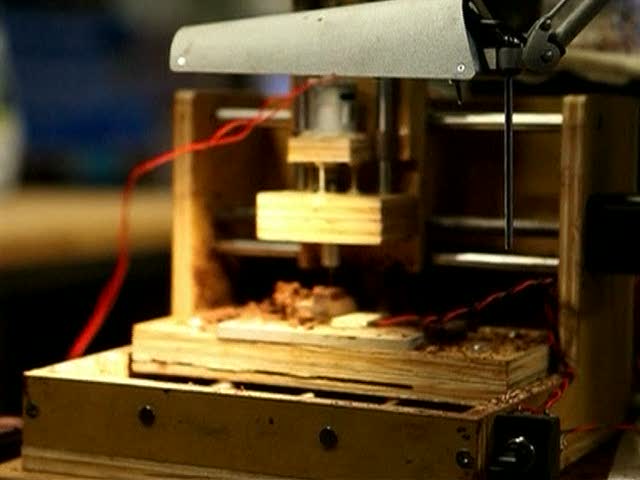 A researcher at MIT has used his technical skills to give chocolate bunnies and eggs a run for their money. David Carr built a new type of 3D printer that uses chocolate to give a new face to Easter treats.
more »
A researcher at MIT has used his technical skills to give chocolate bunnies and eggs a run for their money. David Carr built a new type of 3D printer that uses chocolate to give a new face to Easter treats.
more »
 Storm chasers captured two tornadoes on tape as they touched down in the midwestern United States- continuing a recent onslaught of twisters that have killed dozens and destroyed swathes of land and property.
more »
Storm chasers captured two tornadoes on tape as they touched down in the midwestern United States- continuing a recent onslaught of twisters that have killed dozens and destroyed swathes of land and property.
more »
 A small factory in Brazil's northeast is bringing smiles to the faces of environmentalists by turning used toothpaste tubes into furniture and roof tiles.
more »
A small factory in Brazil's northeast is bringing smiles to the faces of environmentalists by turning used toothpaste tubes into furniture and roof tiles.
more »
 The Lindel family are attempting to live a low carbon life as part of an experiment to cut their carbon emissions from the annual average of seven tonnes per person to only one tonne.
more »
The Lindel family are attempting to live a low carbon life as part of an experiment to cut their carbon emissions from the annual average of seven tonnes per person to only one tonne.
more »
 Three days of severe storms and tornadoes in the southern United States have killed at least 39 people.
more »
Three days of severe storms and tornadoes in the southern United States have killed at least 39 people.
more »
 Disagreements over the stalemated NATO military mission in Libya persist on the first day of the NATO foreign ministers' meeting in Berlin.
more »
Disagreements over the stalemated NATO military mission in Libya persist on the first day of the NATO foreign ministers' meeting in Berlin.
more »
 Tourists go head-to-head with locals in water fights as celebrates its New Year.
more »
Tourists go head-to-head with locals in water fights as celebrates its New Year.
more »
 Six thousand Lego lovers and a crane create the world's largest Lego tower in Sao Paulo.
more »
Six thousand Lego lovers and a crane create the world's largest Lego tower in Sao Paulo.
more »