Israel withdrew from 6.1 percent of the West Bank on Tuesday, giving Palestinian leader Yasser Arafat a stronger hold over about 40 percent of the disputed territories as the two sides headed into talks on a final peace treaty.
Published:
23 March 2000 y., Thursday
The transfer helps create the territorial contiguity Arafat needs for future statehood. Palestinians celebrating the withdrawal said the handover brought them one step closer to Jerusalem, claimed by both sides as a capital.
The Palestinians had demanded suburbs of Jerusalem for the withdrawal that was originally to have taken place Jan. 20, but Israel refused. The dispute stalled negotiations for five weeks.
A compromise gave the Palestinians villages near but not bordering Jerusalem. The withdrawal from lands abutting the Palestinian cities of Hebron, Ramallah and Nablus solidifies Arafat's control over key parts of the West Bank.
In Beitunia, small crowds greeted jeeploads of Palestinian police who rolled into the new territories, firing their rifles into the air in celebration.
Palestinian and Israeli negotiators resumed talks near Washington on Tuesday over a framework agreement for a final peace treaty. The framework is due in May and the final treaty in September. Among issues on the table are Jerusalem, borders, Palestinian refugees and Jewish settlements.
Copying, publishing, announcing any information from the News.lt portal without written permission of News.lt editorial office is prohibited.
The most popular articles
 September 6, literacy courses for local residents were formally opened in the UN Representation in Chaghcharan, capital of province of Ghowr.
more »
September 6, literacy courses for local residents were formally opened in the UN Representation in Chaghcharan, capital of province of Ghowr.
more »
 Lithuania’s Minister of Foreign Affairs Vygaudas Ušackas and Italy’s Minister of Foreign Affairs Franco Frattini discussed perspectives of developing a bilateral dialogue, intensifying economic cooperation, etc.
more »
Lithuania’s Minister of Foreign Affairs Vygaudas Ušackas and Italy’s Minister of Foreign Affairs Franco Frattini discussed perspectives of developing a bilateral dialogue, intensifying economic cooperation, etc.
more »
 During the informal meeting of European Union’s foreign ministers on 4-5 September in Stockholm, Lithuania’s Minister of Foreign Affairs Vygaudas Ušackas and his counterparts discussed the issues of Afghanistan, relations with Iran...
more »
During the informal meeting of European Union’s foreign ministers on 4-5 September in Stockholm, Lithuania’s Minister of Foreign Affairs Vygaudas Ušackas and his counterparts discussed the issues of Afghanistan, relations with Iran...
more »
 On 3 September in Vilnius, Lithuania’s Minister of Foreign Affairs V. Ušackas met with Vice-President of the European Commission G. Verheugen, responsible for enterprise and industry, and discussed the most important issues of economy, energy and the implementation of the Treaty of Lisbon.
more »
On 3 September in Vilnius, Lithuania’s Minister of Foreign Affairs V. Ušackas met with Vice-President of the European Commission G. Verheugen, responsible for enterprise and industry, and discussed the most important issues of economy, energy and the implementation of the Treaty of Lisbon.
more »
 On 22 July, the Government approved of the amendments to the Labour Code proposed by the Ministry of Social Security and Labour.
more »
On 22 July, the Government approved of the amendments to the Labour Code proposed by the Ministry of Social Security and Labour.
more »
 Lithuania’s Minister of Foreign Affairs V. Ušackas discussed the problems of Lithuanian carriers while crossing the Russian border with Igor Levitin, Minister of Transport of the Russian Federation and co-chairman of the Lithuanian-Russian intergovernmental commission.
more »
Lithuania’s Minister of Foreign Affairs V. Ušackas discussed the problems of Lithuanian carriers while crossing the Russian border with Igor Levitin, Minister of Transport of the Russian Federation and co-chairman of the Lithuanian-Russian intergovernmental commission.
more »
 Lithuania‘s Minister of Foreign Affairs welcomed the decision of the new NATO Secretary General Anders Fogh Rasmussen to include a joint representative of the Baltic States into a group of experts which is tasked to prepare a new Strategic Concept of NATO.
more »
Lithuania‘s Minister of Foreign Affairs welcomed the decision of the new NATO Secretary General Anders Fogh Rasmussen to include a joint representative of the Baltic States into a group of experts which is tasked to prepare a new Strategic Concept of NATO.
more »
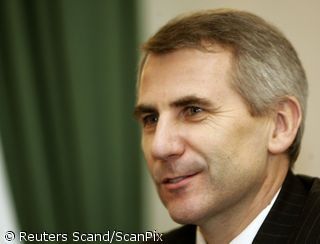 On 3 August, Lithuania’s Minister of Foreign Affairs Vygaudas Ušackas met with Serbia’s Foreign Minister Vuk Jeremić, who was paying a visit to Lithuania.
more »
On 3 August, Lithuania’s Minister of Foreign Affairs Vygaudas Ušackas met with Serbia’s Foreign Minister Vuk Jeremić, who was paying a visit to Lithuania.
more »
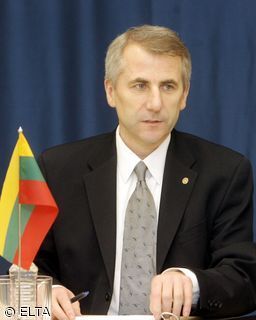 On 30 July, Lithuania’s Minister of Foreign Affairs Vygaudas Ušackas bade farewell to outgoing Ambassador of Belgium to Lithuania Filip Cumps and thanked him for his input into fostering bilateral relations.
more »
On 30 July, Lithuania’s Minister of Foreign Affairs Vygaudas Ušackas bade farewell to outgoing Ambassador of Belgium to Lithuania Filip Cumps and thanked him for his input into fostering bilateral relations.
more »
 On 29 July farewell ceremony with the departing Canadian Defence Attaché for Lithuania Jim Petryk was held in the Ministry of National Defence.
more »
On 29 July farewell ceremony with the departing Canadian Defence Attaché for Lithuania Jim Petryk was held in the Ministry of National Defence.
more »