Israel withdrew from 6.1 percent of the West Bank on Tuesday, giving Palestinian leader Yasser Arafat a stronger hold over about 40 percent of the disputed territories as the two sides headed into talks on a final peace treaty.
Published:
23 March 2000 y., Thursday
The transfer helps create the territorial contiguity Arafat needs for future statehood. Palestinians celebrating the withdrawal said the handover brought them one step closer to Jerusalem, claimed by both sides as a capital.
The Palestinians had demanded suburbs of Jerusalem for the withdrawal that was originally to have taken place Jan. 20, but Israel refused. The dispute stalled negotiations for five weeks.
A compromise gave the Palestinians villages near but not bordering Jerusalem. The withdrawal from lands abutting the Palestinian cities of Hebron, Ramallah and Nablus solidifies Arafat's control over key parts of the West Bank.
In Beitunia, small crowds greeted jeeploads of Palestinian police who rolled into the new territories, firing their rifles into the air in celebration.
Palestinian and Israeli negotiators resumed talks near Washington on Tuesday over a framework agreement for a final peace treaty. The framework is due in May and the final treaty in September. Among issues on the table are Jerusalem, borders, Palestinian refugees and Jewish settlements.
Copying, publishing, announcing any information from the News.lt portal without written permission of News.lt editorial office is prohibited.
The most popular articles
 On 28 July at the square in front of the Ministry of National Defence the solemn initiation ceremony of the assigning of the Chief of Defence of the Republic of Lithuania was held.
more »
On 28 July at the square in front of the Ministry of National Defence the solemn initiation ceremony of the assigning of the Chief of Defence of the Republic of Lithuania was held.
more »
 On 28 July, Lithuania’s Minister of Foreign Affairs Vygaudas Ušackas met with Minister of Foreign Affairs of Bosnia and Herzegovina Sven Alkalaj, who was paying an official visit to Lithuania.
more »
On 28 July, Lithuania’s Minister of Foreign Affairs Vygaudas Ušackas met with Minister of Foreign Affairs of Bosnia and Herzegovina Sven Alkalaj, who was paying an official visit to Lithuania.
more »
 Lithuanian Minister of National Defence and Estonian Defence Minister by phone discussed readiness of Baltic Battalion to be on duty in NATO Response Force after the information that due to extremely difficult economic situation Latvia will decrease its input into the battalion.
more »
Lithuanian Minister of National Defence and Estonian Defence Minister by phone discussed readiness of Baltic Battalion to be on duty in NATO Response Force after the information that due to extremely difficult economic situation Latvia will decrease its input into the battalion.
more »
 In the evening of 27 July in Brussels at the end of the EU foreign ministers’ meeting and before the EU-Belarus consultations, Lithuania’s Minister of Foreign Affairs V. Ušackas met with Minister of Foreign Affairs of Belarus S. Martynov.
more »
In the evening of 27 July in Brussels at the end of the EU foreign ministers’ meeting and before the EU-Belarus consultations, Lithuania’s Minister of Foreign Affairs V. Ušackas met with Minister of Foreign Affairs of Belarus S. Martynov.
more »
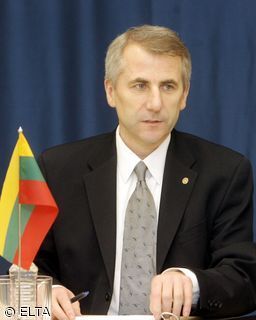 On 27 July in Brussels, Lithuania’s Minister of Foreign Affairs Vygaudas Ušackas and EU Foreign Ministers discussed the situation in Georgia and its neighbourhood.
more »
On 27 July in Brussels, Lithuania’s Minister of Foreign Affairs Vygaudas Ušackas and EU Foreign Ministers discussed the situation in Georgia and its neighbourhood.
more »
 Lithuania’s Minister of Foreign Affairs Vygaudas Ušackas met with Iceland’s Minister for Foreign Affairs Össur Skarphedinsson, Minister of Social Affairs and Social Security Árni Páll Árnason and Chairman of the Parliamentary Committee on Foreign Affairs Árni Thór Sigurdsson.
more »
Lithuania’s Minister of Foreign Affairs Vygaudas Ušackas met with Iceland’s Minister for Foreign Affairs Össur Skarphedinsson, Minister of Social Affairs and Social Security Árni Páll Árnason and Chairman of the Parliamentary Committee on Foreign Affairs Árni Thór Sigurdsson.
more »
 President Dalia Grybauskaitė received the Apostolic Nuncio to Lithuania, Archbishop Luigi Bonazzi.
more »
President Dalia Grybauskaitė received the Apostolic Nuncio to Lithuania, Archbishop Luigi Bonazzi.
more »
 On 23 July in Stockholm, Vice-Minister of Foreign Affairs of Lithuania Asta Skaisgirytė Liauškienė and Swedish Minister for European Affairs Cecilia Malmström discussed priorities of Sweden’s EU Presidency.
more »
On 23 July in Stockholm, Vice-Minister of Foreign Affairs of Lithuania Asta Skaisgirytė Liauškienė and Swedish Minister for European Affairs Cecilia Malmström discussed priorities of Sweden’s EU Presidency.
more »
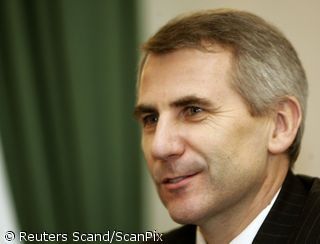 Lithuania’s Acting Minister of Foreign Affairs V. Ušackas had a telephone conversation with Iceland’s Minister for Foreign Affairs Össur Skarphedinsson, during which the Ministers discussed Iceland’s decision to apply for the European Union membership.
more »
Lithuania’s Acting Minister of Foreign Affairs V. Ušackas had a telephone conversation with Iceland’s Minister for Foreign Affairs Össur Skarphedinsson, during which the Ministers discussed Iceland’s decision to apply for the European Union membership.
more »
 Acting in conformity the Constitution of Lithuania and based on the proposal submitted by Prime Minister Andrius Kubilius, President D. Grybauskaitė has approved the Government of the Republic of Lithuania.
more »
Acting in conformity the Constitution of Lithuania and based on the proposal submitted by Prime Minister Andrius Kubilius, President D. Grybauskaitė has approved the Government of the Republic of Lithuania.
more »