Iran's relations with Russia have been gradually improving since the collapse of the Soviet Union, and they bode to become even warmer.
Published:
18 March 2001 y., Sunday
This week Iranian President Mohammad Khatami is in Russia, finding common ground with President Vladimir V. Putin in opposing growing U.S. influence in the energy-rich Caspian Sea region and signing deals--over strong U.S. objections--that will bring Iran access to Russian weapons and nuclear technology.
A secret 1995 agreement with Washington bound Russia from selling arms to Iran. Late last year Moscow pulled out of that accord. Now, an Iranian official says, Iran could be on track to buy up to $7 billion in Russian arms. Ignoring U.S. concerns, Moscow also plans to complete an $800-million nuclear power plant in Iran. The U.S. fear is that Iran's nuclear technology could be turned to weapons production. Iran is believed to be moving toward a nuclear capability and a missile delivery system.
Both presidents expressed displeasure with U.S. activities in the Caspian Sea region, an area of huge oil and gas reserves. Iran and Russia border the Caspian, as do Kazakhstan, Turkmenistan and Azerbaijan, formerly parts of the Soviet Union. Expanding energy production from these fields will require new transportation routes to world markets. For political and security reasons the newly independent states don't want to rely on Russia or Iran as their only export outlet.
Among alternative routes would be a U.S.-endorsed pipeline across Azerbaijan, Georgia and Turkey. American energy companies are already active in the Caspian region. Increased Caspian exports could reduce the world's overdependence on Middle Eastern suppliers. Caspian development would also probably boost U.S. influence in the area's newly independent states and help them resist political inroads by Russia and Iran. That prospect is one of the considerations working to bring Moscow and Tehran closer.
Šaltinis:
Los Angeles Times
Copying, publishing, announcing any information from the News.lt portal without written permission of News.lt editorial office is prohibited.
The most popular articles
 Heads of foreign states bid farewell to the late President of the Republic of Lithuania, Algirdas Mykolas Brazauskas.
more »
Heads of foreign states bid farewell to the late President of the Republic of Lithuania, Algirdas Mykolas Brazauskas.
more »
 Today we say farewell to one of the most prominent Lithuanian politicians, a sincere and open person, a man of principle, Algirdas Brazauskas - the first directly elected president of Lithuania after re-independence.
more »
Today we say farewell to one of the most prominent Lithuanian politicians, a sincere and open person, a man of principle, Algirdas Brazauskas - the first directly elected president of Lithuania after re-independence.
more »
 Head of Cabinet of the Secretary General of the Council of the European Union Marek Mora is paying a visit to Lithuania from 30 June to 1 July.
more »
Head of Cabinet of the Secretary General of the Council of the European Union Marek Mora is paying a visit to Lithuania from 30 June to 1 July.
more »
 Lithuania‘s Minister of Foreign Affairs A. Ažubalis says, that continuous implementation of the Treaty of Lisbon, energy security, as well as European Union‘s relations with Eastern Neighbourhood countries and Russia would stay on the list of European policy issues that are the most important to Lithuania in the second half of 2010.
more »
Lithuania‘s Minister of Foreign Affairs A. Ažubalis says, that continuous implementation of the Treaty of Lisbon, energy security, as well as European Union‘s relations with Eastern Neighbourhood countries and Russia would stay on the list of European policy issues that are the most important to Lithuania in the second half of 2010.
more »
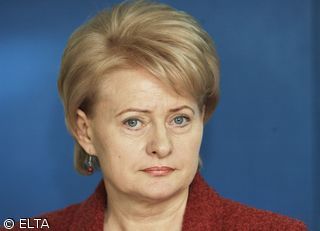 President of the Republic of Lithuania Dalia Grybauskaitė calls the decisions adopted by the European Council strategic and important for Lithuania and for the whole European Union.
more »
President of the Republic of Lithuania Dalia Grybauskaitė calls the decisions adopted by the European Council strategic and important for Lithuania and for the whole European Union.
more »
 On 16 June in Vilnius, Lithuania’s Minister of Foreign Affairs Audronius Ažubalis and Poland’s Minister of National Defence Bogdan Klich discussed successful bilateral cooperation on security and defence matters.
more »
On 16 June in Vilnius, Lithuania’s Minister of Foreign Affairs Audronius Ažubalis and Poland’s Minister of National Defence Bogdan Klich discussed successful bilateral cooperation on security and defence matters.
more »
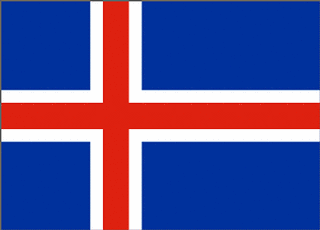 President of the Republic of Lithuania Dalia Grybauskaitė sent congratulations to President Ólafur Ragnar Grímsson of the Republic of Iceland on Iceland's national holiday, the Independence Day.
more »
President of the Republic of Lithuania Dalia Grybauskaitė sent congratulations to President Ólafur Ragnar Grímsson of the Republic of Iceland on Iceland's national holiday, the Independence Day.
more »
 President of the Republic of Lithuania Dalia Grybauskaitė goes on an official visit to the Grand Duchy of Luxembourg.
more »
President of the Republic of Lithuania Dalia Grybauskaitė goes on an official visit to the Grand Duchy of Luxembourg.
more »
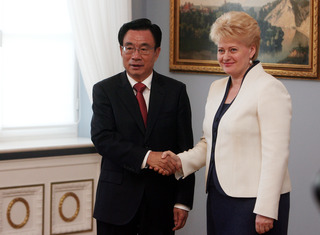 President of the Republic of Lithuania Dalia Grybauskaitė received a high-ranking government official from China, He Guoqiang.
more »
President of the Republic of Lithuania Dalia Grybauskaitė received a high-ranking government official from China, He Guoqiang.
more »
 On the occasion of European Day for Border Guards, the 10th of June, heads of diplomatic missions of the European Union member states in Lithuania visited the Border Guard School in Medininkai.
more »
On the occasion of European Day for Border Guards, the 10th of June, heads of diplomatic missions of the European Union member states in Lithuania visited the Border Guard School in Medininkai.
more »