Moldova was one of the first countries mentioned by EU leaders as a candidate for closer cooperation
Published:
31 October 2004 y., Sunday
Moldova was one of the first countries mentioned by EU leaders as a candidate for closer cooperation. Andre Wilkens and Viorel Ursu make the case for keeping the door open for possible future membership of the country in the Union, while highlighting the remaining areas of volatility, which could be bolstered with the success of the ENP.
There is no doubt that Moldova is not yet ready to join the EU: its institutions are weak, its political leadership is corrupt, its economy is one of the poorest in Europe, and its relationship with the separatists remains tenuous. The OSCE and the Council of Europe are consistently critical of Moldova's electoral process and the suppression of the opposition by the governing party. The judicial system is inefficient, mainly because judges are vulnerable to external pressure and bribery. International and local civil society organisations have accused Moldova of numerous human rights violations, including infringements on freedom of expression and association, lack of media independence, and ill-treatment of prisoners. The country is so poor that some 300,000 Moldovans have emigrated in the last five years to seek better opportunities abroad.
But Moldova's situation is similar to those of some of the Western Balkan countries that were given the chance to qualify for the EU game as well as many of new Eastern European members when they started negotiations. Who could have predicted 15 years ago that the EU 2004 would include countries from the former Soviet Union? It was the chance at EU membership that stimulated their transformation process.
The Euroteam wants strong players that share the same values and play according to the EU rules. In fact, this was the starting point for creating the European Communities, turning competing, vulnerable countries into team players who created a growing force of peace, stability, democracy and prosperity.
Šaltinis:
azi.md
Copying, publishing, announcing any information from the News.lt portal without written permission of News.lt editorial office is prohibited.
The most popular articles
 The yesterday‘s working dinner of the Prime Ministers of NB8 focused on the EU-Russia relations and energy security issues.
more »
The yesterday‘s working dinner of the Prime Ministers of NB8 focused on the EU-Russia relations and energy security issues.
more »
 Today, Prime Minister Gediminas Kirkilas has taken part at the Prime Minister meeting NB8 of Baltic and Nordic States (Denmark, Estonia, Island, Latvia, Lithuania, Norway, Finland and Sweden).
more »
Today, Prime Minister Gediminas Kirkilas has taken part at the Prime Minister meeting NB8 of Baltic and Nordic States (Denmark, Estonia, Island, Latvia, Lithuania, Norway, Finland and Sweden).
more »
 President Adamkus expresses confidence that Lithuania and Turkmenistan, cherishing their friendly interrelations, will make joint efforts towards a deeper and more dynamic bilateral cooperation.
more »
President Adamkus expresses confidence that Lithuania and Turkmenistan, cherishing their friendly interrelations, will make joint efforts towards a deeper and more dynamic bilateral cooperation.
more »
 On Monday, October 27, Prime Minister Gediminas Kirkilas departs for Helsinki in order to attend an annual meeting of the Prime Ministers of the Nordic and Baltic States.
more »
On Monday, October 27, Prime Minister Gediminas Kirkilas departs for Helsinki in order to attend an annual meeting of the Prime Ministers of the Nordic and Baltic States.
more »
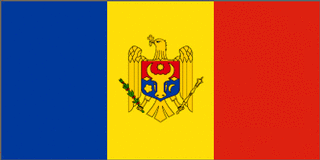 On 23 October, Moldovan officials responsible for the issues of European integration are visiting Vilnius at the initiative of Lithuanian Ministry of Foreign Affairs.
more »
On 23 October, Moldovan officials responsible for the issues of European integration are visiting Vilnius at the initiative of Lithuanian Ministry of Foreign Affairs.
more »
 President of the Republic of Lithuania Valdas Adamkus received UNICEF Goodwill Ambassador Angélique Kidjo and vocal group “Ladysmith Black Mambazo”.
more »
President of the Republic of Lithuania Valdas Adamkus received UNICEF Goodwill Ambassador Angélique Kidjo and vocal group “Ladysmith Black Mambazo”.
more »
 President of the Republic of Lithuania Valdas Adamkus extended condolences on behalf of himself and the people of Lithuania to the members and friends of the Sugihara family on the death of Mrs. Yukiko Sugihara, the wife of Chiune Sugihara.
more »
President of the Republic of Lithuania Valdas Adamkus extended condolences on behalf of himself and the people of Lithuania to the members and friends of the Sugihara family on the death of Mrs. Yukiko Sugihara, the wife of Chiune Sugihara.
more »
On Monday, October 27, Prime Minister Gediminas Kirkilas departs for Helsinki in order to attend an annual meeting of the Prime Ministers of the Nordic and Baltic States.
more »
 According to the 2008 October public poll results, 75 percent of respondents were in favour of Lithuania’s membership of the European Union, 15 percent were against, and 10 percent were undecided regarding the issue.
more »
According to the 2008 October public poll results, 75 percent of respondents were in favour of Lithuania’s membership of the European Union, 15 percent were against, and 10 percent were undecided regarding the issue.
more »
 President of the Republic of Lithuania Valdas Adamkus observed the international military exercise Strong Shield 2008.
more »
President of the Republic of Lithuania Valdas Adamkus observed the international military exercise Strong Shield 2008.
more »