Ms Irena Degutienė, Speaker of the Seimas of the Republic of Lithuania, participated in the International Conference Europe 70 years after the Molotov–Ribbentrop Pact held by the European Parliament.
Ms Irena Degutienė
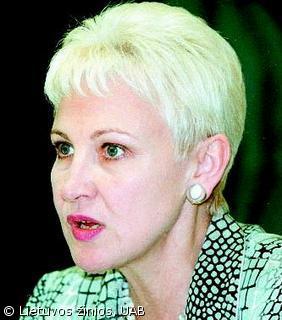 |
Ms Irena Degutienė, Speaker of the Seimas of the Republic of Lithuania, participated in the International Conference Europe 70 years after the Molotov–Ribbentrop Pact held by the European Parliament.
Welcoming the Conference participants, the Speaker of the Seimas underlined that our aspiration was common Europe with 27 different historical experiences, underpinned by the unified perception of history. That is why it is important to have a single view on the crimes of totalitarian regimes, which neglected universal human rights and freedoms.
“The assessment of Stalinist crimes is significant not only for the Baltic States or for Eastern and Central Europe. I am convinced that adequate evaluation of the crimes committed by the totalitarian regimes and, most importantly, of their consequences must become part and parcel of the common European identity and the shared value system,” Ms Degutienė said.
The Speaker of the Seimas highlighted that the European Union had already taken the first steps for evaluating the Soviet and Nazi totalitarian regimes, and urged to consolidate the efforts of the EU institutions and Member States for continuing the work begun.
Irena Degutienė welcomed the invitation of the European Parliament to EU Member States to proclaim the 23rd of August the European Day of Remembrance for Victims of Stalinism and Nazism, and the aspiration to establish, in the shortest time, the European Platform of Memory and Conscience - network for cooperation between research centres and non-governmental organisations in Europe. In the opinion of the Speaker of the Seimas, the network will assist in deepening the Europeans’ historical knowledge, contributing to the general understanding of the crimes committed by the totalitarian regimes, and allowing to perpetuate the memory of the victims of Stalinism and Nazism.
“I truly think that we must continue doing the job in order to preserve the historical memory and, particularly, to deepen the knowledge and realisation by our societies (the young generation in particular) of what a large part of our and EU citizens had to go through,” Ms Degutienė said. “That is the only way to strengthen mutual understanding, to prevent intolerance, extremism, and similar phenomena in the future,” the Speaker of the Lithuanian Parliament underlined.
Ms Degutienė urged to include the issue of totalitarianism in the Stockholm Programme and thus secure it on the EU agenda.
“The evaluation of the Soviet and Nazi totalitarian regimes is not a mere historical demand. My response to those claiming that the past is a matter for historians is as follows: the past might be a matter for historians but justice is a political principle, therefore the past becomes an issue for political communities and the matter of the common EU interest,” Ms Degutienė emphasised. “A political and moral Union of Europeans striving for justice must build on universal and perpetual values. Without them, justice on Monday would be seen differently than on Tuesday, depending on the evaluation day and a political disposition of the evaluator. We have to realise that the greatest tyrannies of the 20th century – the Soviet and Nazi totalitarian regimes – should be evaluated not only historically but also on the basis of universal and perpetual values, as well as on moral and political wisdom”.
At the International Conference Europe 70 years after the Molotov–Ribbentrop Pact, the opening speeches were also delivered by Jerzy Buzek, President of the European Parliament, Gundars Daudze, Chairman of the Latvian Parliament, Vytautas Landsbergis, former President of the Constitutional Assembly of the Republic of Lithuania - Head of State, Member of the European Parliament, and Maria Åsenius, State Secretary for EU Affairs, Office of the Prime Minister of the Kingdom of Sweden.
The Conference brings together Members of the European Parliament and the European Commission, the academic community, NGOs, and experts.
The Conference held at the European Parliament is going to review the historical events of 1939, the Molotov–Ribbentrop Pact and its consequences to further developments in Europe, as well as to celebrate the 20th anniversary of the opening of the Iron Curtain and to debate further steps needed to safeguard the historical memory and to deepen public awareness about the crimes of the two largest totalitarian regimes of the 20th century.