Austrian political parties and leaders are now actively involved in negotiations over the formation of a new governmental program and coalition.
Published:
1 November 1999 y., Monday
On Monday, the leader of the OVP (People_s Party) and incumbent foreign minister, Wolfgang Schuessel, stated during a press conference that Europe and the necessity for a "new quality of democracy" were among the topics that his party intended to raise during the discussions. Most significantly, Schuessel argued for a change in the traditional understanding of neutrality, which would be achieved by the replacement of the neutrality clause with a "peace" clause (Friedensgebot). The proposal would, for instance, involve the commitment of Austrian troops for "peaceful goals," as well as prohibiting foreign troops or nuclear weapons to be stationed in Austria unless otherwise approved in a referendum. In an interview with the newsmagazine Format, Schuessel stated that, "[Austria is] part of the European normality, [and] special ways are not possible any longer. Therefore, we can throw to the dustbin electoral posters such as _no budgetary cuts_ or no NATO membership". Chancellor Viktor Klima conducted negotiations this week with the OVP and the Greens, making clear on Thurday evening that his aim was a renewal of the SPO-OVP coalition. Were this option to prove unattainable, he would propose to President Thomas Klestil a government made of a wide spectrum of personalities without a fixed coalition agreement. Klima ruled out the possibility of a one-to-one meeting with Joerg Haider. As a result, negotiations between the SPO and Haider_s Freedom Party (FPO) will take place next week at a delegation level.
Copying, publishing, announcing any information from the News.lt portal without written permission of News.lt editorial office is prohibited.
The most popular articles
 Lithuania took over the Chairmanship of the Organization for Security and Co-operation in Europe today, with a focus on internal and external threats in the OSCE area, fostering democracy, human rights and fundamental freedoms, notably freedom of the media, promoting energy security in Europe and building upon synergies between regional organizations.
more »
Lithuania took over the Chairmanship of the Organization for Security and Co-operation in Europe today, with a focus on internal and external threats in the OSCE area, fostering democracy, human rights and fundamental freedoms, notably freedom of the media, promoting energy security in Europe and building upon synergies between regional organizations.
more »
 President of the Republic of Lithuania Dalia Grybauskaitė says the decision taken by the European Council to amend the EU Treaty to provide for the establishment of a permanent support mechanism for crisis–stricken eurozone countries is very important for Lithuania.
more »
President of the Republic of Lithuania Dalia Grybauskaitė says the decision taken by the European Council to amend the EU Treaty to provide for the establishment of a permanent support mechanism for crisis–stricken eurozone countries is very important for Lithuania.
more »
 At the OSCE Summit, President of the Republic of Lithuania Dalia Grybauskaitė met with President of the Kyrgyz Republic Roza Otunbayeva for a bilateral discussion.
more »
At the OSCE Summit, President of the Republic of Lithuania Dalia Grybauskaitė met with President of the Kyrgyz Republic Roza Otunbayeva for a bilateral discussion.
more »
President of the Republic of Lithuania Dalia Grybauskaitė attending OSCE Summit in Astana had a conversation with US Secretary of State Hillary Clinton.
more »
 President Dalia Grybauskaitė positively assessed the European Commission's decision to include the integration of the Baltic Energy Market into the European market in the map of EU priorities.
more »
President Dalia Grybauskaitė positively assessed the European Commission's decision to include the integration of the Baltic Energy Market into the European market in the map of EU priorities.
more »
 President of the Republic of Lithuania Dalia Grybauskaitė left to Lisbon to attend NATO Summit that starts today.
more »
President of the Republic of Lithuania Dalia Grybauskaitė left to Lisbon to attend NATO Summit that starts today.
more »
 President of the Republic of Lithuania Dalia Grybauskaitė congratulated President Valdis Zatlers of the Republic of Latvia and all Latvian people on Latvia's national holiday, the Independence Day.
more »
President of the Republic of Lithuania Dalia Grybauskaitė congratulated President Valdis Zatlers of the Republic of Latvia and all Latvian people on Latvia's national holiday, the Independence Day.
more »
President of the Republic of Lithuania Dalia Grybauskaitė received letters of credence from the Ambassador of the Islamic Republic of Iran, Samad Ali Lakizadeh.
more »
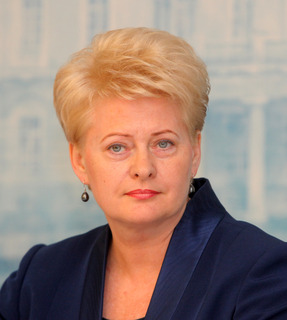 President of the Republic of Lithuania Dalia Grybauskaitė received letters of credence from the Ambassador of the United Arab Emirates, Mohammed Ahmed Al Mahmood.
more »
President of the Republic of Lithuania Dalia Grybauskaitė received letters of credence from the Ambassador of the United Arab Emirates, Mohammed Ahmed Al Mahmood.
more »
 As a response to the address made by representatives of Lithuania's culture community and civic society concerning the future of Kristijonas Donelaitis museum in Chistye Prudy in the Kaliningrad Oblast, President of the Republic of Lithuania D. Grybauskaitė sent a letter to President D. Medvedev of the Russian Federation.
more »
As a response to the address made by representatives of Lithuania's culture community and civic society concerning the future of Kristijonas Donelaitis museum in Chistye Prudy in the Kaliningrad Oblast, President of the Republic of Lithuania D. Grybauskaitė sent a letter to President D. Medvedev of the Russian Federation.
more »