Austrian political parties and leaders are now actively involved in negotiations over the formation of a new governmental program and coalition.
Published:
1 November 1999 y., Monday
On Monday, the leader of the OVP (People_s Party) and incumbent foreign minister, Wolfgang Schuessel, stated during a press conference that Europe and the necessity for a "new quality of democracy" were among the topics that his party intended to raise during the discussions. Most significantly, Schuessel argued for a change in the traditional understanding of neutrality, which would be achieved by the replacement of the neutrality clause with a "peace" clause (Friedensgebot). The proposal would, for instance, involve the commitment of Austrian troops for "peaceful goals," as well as prohibiting foreign troops or nuclear weapons to be stationed in Austria unless otherwise approved in a referendum. In an interview with the newsmagazine Format, Schuessel stated that, "[Austria is] part of the European normality, [and] special ways are not possible any longer. Therefore, we can throw to the dustbin electoral posters such as _no budgetary cuts_ or no NATO membership". Chancellor Viktor Klima conducted negotiations this week with the OVP and the Greens, making clear on Thurday evening that his aim was a renewal of the SPO-OVP coalition. Were this option to prove unattainable, he would propose to President Thomas Klestil a government made of a wide spectrum of personalities without a fixed coalition agreement. Klima ruled out the possibility of a one-to-one meeting with Joerg Haider. As a result, negotiations between the SPO and Haider_s Freedom Party (FPO) will take place next week at a delegation level.
Copying, publishing, announcing any information from the News.lt portal without written permission of News.lt editorial office is prohibited.
The most popular articles
 On 28 July at the square in front of the Ministry of National Defence the solemn initiation ceremony of the assigning of the Chief of Defence of the Republic of Lithuania was held.
more »
On 28 July at the square in front of the Ministry of National Defence the solemn initiation ceremony of the assigning of the Chief of Defence of the Republic of Lithuania was held.
more »
 On 28 July, Lithuania’s Minister of Foreign Affairs Vygaudas Ušackas met with Minister of Foreign Affairs of Bosnia and Herzegovina Sven Alkalaj, who was paying an official visit to Lithuania.
more »
On 28 July, Lithuania’s Minister of Foreign Affairs Vygaudas Ušackas met with Minister of Foreign Affairs of Bosnia and Herzegovina Sven Alkalaj, who was paying an official visit to Lithuania.
more »
 Lithuanian Minister of National Defence and Estonian Defence Minister by phone discussed readiness of Baltic Battalion to be on duty in NATO Response Force after the information that due to extremely difficult economic situation Latvia will decrease its input into the battalion.
more »
Lithuanian Minister of National Defence and Estonian Defence Minister by phone discussed readiness of Baltic Battalion to be on duty in NATO Response Force after the information that due to extremely difficult economic situation Latvia will decrease its input into the battalion.
more »
 In the evening of 27 July in Brussels at the end of the EU foreign ministers’ meeting and before the EU-Belarus consultations, Lithuania’s Minister of Foreign Affairs V. Ušackas met with Minister of Foreign Affairs of Belarus S. Martynov.
more »
In the evening of 27 July in Brussels at the end of the EU foreign ministers’ meeting and before the EU-Belarus consultations, Lithuania’s Minister of Foreign Affairs V. Ušackas met with Minister of Foreign Affairs of Belarus S. Martynov.
more »
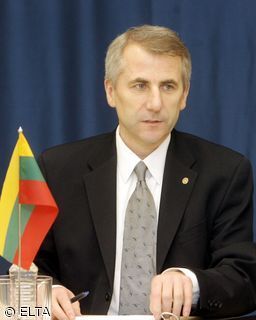 On 27 July in Brussels, Lithuania’s Minister of Foreign Affairs Vygaudas Ušackas and EU Foreign Ministers discussed the situation in Georgia and its neighbourhood.
more »
On 27 July in Brussels, Lithuania’s Minister of Foreign Affairs Vygaudas Ušackas and EU Foreign Ministers discussed the situation in Georgia and its neighbourhood.
more »
 Lithuania’s Minister of Foreign Affairs Vygaudas Ušackas met with Iceland’s Minister for Foreign Affairs Össur Skarphedinsson, Minister of Social Affairs and Social Security Árni Páll Árnason and Chairman of the Parliamentary Committee on Foreign Affairs Árni Thór Sigurdsson.
more »
Lithuania’s Minister of Foreign Affairs Vygaudas Ušackas met with Iceland’s Minister for Foreign Affairs Össur Skarphedinsson, Minister of Social Affairs and Social Security Árni Páll Árnason and Chairman of the Parliamentary Committee on Foreign Affairs Árni Thór Sigurdsson.
more »
 President Dalia Grybauskaitė received the Apostolic Nuncio to Lithuania, Archbishop Luigi Bonazzi.
more »
President Dalia Grybauskaitė received the Apostolic Nuncio to Lithuania, Archbishop Luigi Bonazzi.
more »
 On 23 July in Stockholm, Vice-Minister of Foreign Affairs of Lithuania Asta Skaisgirytė Liauškienė and Swedish Minister for European Affairs Cecilia Malmström discussed priorities of Sweden’s EU Presidency.
more »
On 23 July in Stockholm, Vice-Minister of Foreign Affairs of Lithuania Asta Skaisgirytė Liauškienė and Swedish Minister for European Affairs Cecilia Malmström discussed priorities of Sweden’s EU Presidency.
more »
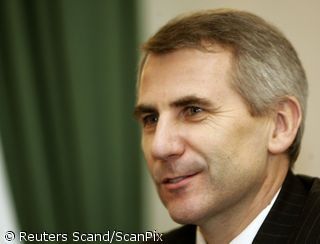 Lithuania’s Acting Minister of Foreign Affairs V. Ušackas had a telephone conversation with Iceland’s Minister for Foreign Affairs Össur Skarphedinsson, during which the Ministers discussed Iceland’s decision to apply for the European Union membership.
more »
Lithuania’s Acting Minister of Foreign Affairs V. Ušackas had a telephone conversation with Iceland’s Minister for Foreign Affairs Össur Skarphedinsson, during which the Ministers discussed Iceland’s decision to apply for the European Union membership.
more »
 Acting in conformity the Constitution of Lithuania and based on the proposal submitted by Prime Minister Andrius Kubilius, President D. Grybauskaitė has approved the Government of the Republic of Lithuania.
more »
Acting in conformity the Constitution of Lithuania and based on the proposal submitted by Prime Minister Andrius Kubilius, President D. Grybauskaitė has approved the Government of the Republic of Lithuania.
more »