Reports of the redeployment of Russian nuclear arms in the Kaliningrad region along the Baltic Sea has rekindled fears in Poland of a nuclear menace along its borders.
Published:
6 January 2001 y., Saturday
Reports of the redeployment of Russian nuclear arms in the Kaliningrad region along the Baltic Sea has rekindled fears in Poland of a nuclear menace along its borders.
As communism collapsed both NATO and the Soviet Union withdrew forward-deployed nuclear weapons, leaving Poland in a comfortable non-nuclear zone in central Europe, but the country which joined NATO in 1999 now finds itself unsettled at the prospect of being on a front line.
Polish officials have called for international verification of a report in the Washington Times earlier this week that quoted U.S. intelligence sources as saying that Russia has moved nuclear weapons into the enclave.
Russia on Wednesday flatly denied putting nuclear weapons back into the Kaliningrad region.
Russia has a strong military presence in Kaliningrad -- sandwiched between Poland and Lithuania along the Baltic Sea coast -- and any deployment of nuclear arms there would be a serious cause for concern, the Polish defense minister said on Friday.
A U.S. Pentagon official confirmed late Wednesday that Russia is believed to have moved short-range nuclear-capable weapons into the enclave and said it was part of a "disturbing trend" that raises questions about Moscow's commitment to pledges it has made on arms control. The Polish daily Rzeczpospolita reported Friday the Polish government has obtained from NATO satellite photos confirming the deployment of missiles capable of carrying nuclear weapons.
The paper quoted a high-level NATO source as saying that "satellite photos have confirmed the deployment last June of new missiles in Kaliningrad, but we cannot be 100 percent certain they contain nuclear warheads."
Šaltinis:
Agence France Presse
Copying, publishing, announcing any information from the News.lt portal without written permission of News.lt editorial office is prohibited.
The most popular articles
 Heads of foreign states bid farewell to the late President of the Republic of Lithuania, Algirdas Mykolas Brazauskas.
more »
Heads of foreign states bid farewell to the late President of the Republic of Lithuania, Algirdas Mykolas Brazauskas.
more »
 Today we say farewell to one of the most prominent Lithuanian politicians, a sincere and open person, a man of principle, Algirdas Brazauskas - the first directly elected president of Lithuania after re-independence.
more »
Today we say farewell to one of the most prominent Lithuanian politicians, a sincere and open person, a man of principle, Algirdas Brazauskas - the first directly elected president of Lithuania after re-independence.
more »
 Head of Cabinet of the Secretary General of the Council of the European Union Marek Mora is paying a visit to Lithuania from 30 June to 1 July.
more »
Head of Cabinet of the Secretary General of the Council of the European Union Marek Mora is paying a visit to Lithuania from 30 June to 1 July.
more »
 Lithuania‘s Minister of Foreign Affairs A. Ažubalis says, that continuous implementation of the Treaty of Lisbon, energy security, as well as European Union‘s relations with Eastern Neighbourhood countries and Russia would stay on the list of European policy issues that are the most important to Lithuania in the second half of 2010.
more »
Lithuania‘s Minister of Foreign Affairs A. Ažubalis says, that continuous implementation of the Treaty of Lisbon, energy security, as well as European Union‘s relations with Eastern Neighbourhood countries and Russia would stay on the list of European policy issues that are the most important to Lithuania in the second half of 2010.
more »
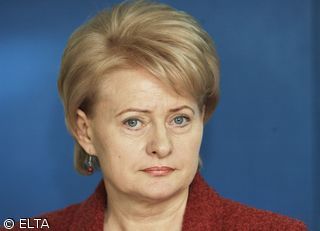 President of the Republic of Lithuania Dalia Grybauskaitė calls the decisions adopted by the European Council strategic and important for Lithuania and for the whole European Union.
more »
President of the Republic of Lithuania Dalia Grybauskaitė calls the decisions adopted by the European Council strategic and important for Lithuania and for the whole European Union.
more »
 On 16 June in Vilnius, Lithuania’s Minister of Foreign Affairs Audronius Ažubalis and Poland’s Minister of National Defence Bogdan Klich discussed successful bilateral cooperation on security and defence matters.
more »
On 16 June in Vilnius, Lithuania’s Minister of Foreign Affairs Audronius Ažubalis and Poland’s Minister of National Defence Bogdan Klich discussed successful bilateral cooperation on security and defence matters.
more »
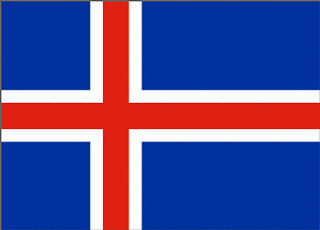 President of the Republic of Lithuania Dalia Grybauskaitė sent congratulations to President Ólafur Ragnar Grímsson of the Republic of Iceland on Iceland's national holiday, the Independence Day.
more »
President of the Republic of Lithuania Dalia Grybauskaitė sent congratulations to President Ólafur Ragnar Grímsson of the Republic of Iceland on Iceland's national holiday, the Independence Day.
more »
 President of the Republic of Lithuania Dalia Grybauskaitė goes on an official visit to the Grand Duchy of Luxembourg.
more »
President of the Republic of Lithuania Dalia Grybauskaitė goes on an official visit to the Grand Duchy of Luxembourg.
more »
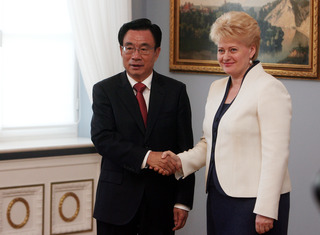 President of the Republic of Lithuania Dalia Grybauskaitė received a high-ranking government official from China, He Guoqiang.
more »
President of the Republic of Lithuania Dalia Grybauskaitė received a high-ranking government official from China, He Guoqiang.
more »
 On the occasion of European Day for Border Guards, the 10th of June, heads of diplomatic missions of the European Union member states in Lithuania visited the Border Guard School in Medininkai.
more »
On the occasion of European Day for Border Guards, the 10th of June, heads of diplomatic missions of the European Union member states in Lithuania visited the Border Guard School in Medininkai.
more »