State Department unveiling Cuba Web site.
Published:
9 November 1999 y., Tuesday
In a bid to help Americans understand the maze of rules and regulations governing travel to Cuba, the U.S. embargo against the island and related issues, the State Department is unveiling a new Web site focused exclusively on Cuba. The Web site, ready to go on line today after highly secretive preparations, is largely fact-based but also highlights, with the help of pictures, the shortcomings of the revolution in such areas as housing and transportation. The State Department has many other Web sites devoted to individual countries. But creating a Cuba site has been more of a challenge than most because of the complexity of the issues and because of the passions Cuba continues to generate even after 40 years of communist rule.Visitors to the Web site can obtain information about human rights in Cuba, the administration_s efforts to promote people-to-people contacts, U.S.-Cuban relations, migration, restrictions on the sale of medicine, labor practices on the island and details of 1996 legislation designed to assist Americans whose property was seized by the revolution without compensation. "This is not at all intended to be an affront," said a State Department official, asking not to be identified. "It is intended to clarify our policy." But coupled with policy clarifications are the unflattering pictures. One picture showing rundown housing was accompanied by a caption that reads: "Cuba_s state-controlled economy has failed to provide adequate housing to Cubans. Multi-family occupancy of often unsafe housing is common." Another section of the Web site is devoted to four dissident leaders who were convicted earlier this year for sedition and acts against the security of the state. The four are widely portrayed internationally as victims of repression.
Copying, publishing, announcing any information from the News.lt portal without written permission of News.lt editorial office is prohibited.
The most popular articles
 On 26 November, Lithuania’s Minister of Foreign Affairs Vygaudas Ušackas delivered a lecture “The New NATO Strategic Concept: Lithuania’s Vision” to the participants of Higher Command Studies Course of the Baltic Defence College (BALTDEFCOL).
more »
On 26 November, Lithuania’s Minister of Foreign Affairs Vygaudas Ušackas delivered a lecture “The New NATO Strategic Concept: Lithuania’s Vision” to the participants of Higher Command Studies Course of the Baltic Defence College (BALTDEFCOL).
more »
 On 25 November at the European Information Bureau of the Seimas, Lithuania’s Minister of Foreign Affairs Vygaudas Ušackas took part in the round table discussion “Climate Change: from Kyoto to Copenhagen” and spoke about Lithuania’s contribution to combating climate change.
more »
On 25 November at the European Information Bureau of the Seimas, Lithuania’s Minister of Foreign Affairs Vygaudas Ušackas took part in the round table discussion “Climate Change: from Kyoto to Copenhagen” and spoke about Lithuania’s contribution to combating climate change.
more »
 President of the Republic of Lithuania Dalia Grybauskaitė goes for a working visit to Ukraine to attend a session of the Council of Presidents of the Republic of Lithuania and Ukraine and to meet with Ukraine's President Viktor Yushchenko.
more »
President of the Republic of Lithuania Dalia Grybauskaitė goes for a working visit to Ukraine to attend a session of the Council of Presidents of the Republic of Lithuania and Ukraine and to meet with Ukraine's President Viktor Yushchenko.
more »
 Today, November 26, meeting of the Baltic Chiefs of Defence will begin in General Adolfas Ramanauskas Warfare Training Centre in Nemenčinė (Vilnius distr.).
more »
Today, November 26, meeting of the Baltic Chiefs of Defence will begin in General Adolfas Ramanauskas Warfare Training Centre in Nemenčinė (Vilnius distr.).
more »
 November 24, Defence Attachés accredited to Lithuania met at MoND to address international defence cooperation of Lithuania, activities and plans of the Lithuanian-led Chaghcharan PRT.
more »
November 24, Defence Attachés accredited to Lithuania met at MoND to address international defence cooperation of Lithuania, activities and plans of the Lithuanian-led Chaghcharan PRT.
more »
 President Dalia Grybauskaitė extended congratulations to President Mikheil Saakashvili of Georgia on the occasion of national holiday.
more »
President Dalia Grybauskaitė extended congratulations to President Mikheil Saakashvili of Georgia on the occasion of national holiday.
more »
 This year marks the 20th anniversary of the collapse of communism in Europe and the end of the Cold War.
more »
This year marks the 20th anniversary of the collapse of communism in Europe and the end of the Cold War.
more »
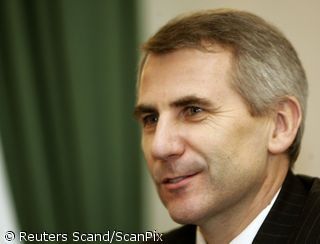 Today Lithuania‘s Minister of Foreign Affairs Vygaudas Ušackas is starting his official visit to Armenia where he will meet with the highest ranking officials of the state, as well as with the representatives of the international organizations and local authorities.
more »
Today Lithuania‘s Minister of Foreign Affairs Vygaudas Ušackas is starting his official visit to Armenia where he will meet with the highest ranking officials of the state, as well as with the representatives of the international organizations and local authorities.
more »
 On 20 November, Lithuania’s Minister of Foreign Affairs Vygaudas Ušackas congratulated Catherine Ashton who had just been elected as European Union‘s High Representative for Foreign Affairs and Security Policy.
more »
On 20 November, Lithuania’s Minister of Foreign Affairs Vygaudas Ušackas congratulated Catherine Ashton who had just been elected as European Union‘s High Representative for Foreign Affairs and Security Policy.
more »
 On 20 November, Lithuania’s Ministry of Foreign Affairs in cooperation with the Lithuanian business confederation | ICC Lithuania will host a seminar “Business in sub-Saharan Africa: Possibilities and Challenges”.
more »
On 20 November, Lithuania’s Ministry of Foreign Affairs in cooperation with the Lithuanian business confederation | ICC Lithuania will host a seminar “Business in sub-Saharan Africa: Possibilities and Challenges”.
more »