WESTERN SUPPORT FOR BALTIC MEMBERSHIP IN NATO INCREASES
Published:
20 October 2001 y., Saturday
Some Western commentators have expressed concern that Russia's inclusion within the international coalition against terrorism will lead to it demanding concessions from the U.S. in areas such as NATO enlargement. These fears seem to be increasingly unwarranted as the range of Western countries that have voiced their support for the inclusion of the Baltic states continues to grow. There are even indications that Russian President Vladimir Putin may be withdrawing his "red line" to the CIS, which would no longer include the Baltic states within its sphere of influence.
At that meeting, the representatives of the three Baltic states drafted a position statement that argued that at the summit scheduled for November 2002 in Prague NATO should invite all nine aspirant states to join at the same time and not individually.
The Baltic republics initially looked to the U.S., Scandinavian countries, and Central European NATO members Poland, the Czech Republic, and Hungary as their main supporters in their bid for NATO membership. On recent visits to the Baltic states, Polish President Aleksandr Kwasniewski and Polish Foreign Minister Wladyslaw Bartoszewski both came out strongly in favor of Baltic membership. These views were also expressed by Hungarian Defense Minister Janos Szabo to the Hungarian parliament earlier this month.
Scandinavia has been at the forefront of promoting the Baltic states within NATO. At a Helsinki summit in August, Foreign Ministers from Denmark, Norway, Iceland, Sweden, and Finland expressed their firm support for the Balts to be included within NATO.
Support within NATO has expanded beyond the Central Europe and Scandinavia. Then-Turkish President Suleyman Demirel told his visiting Estonian counterpart as early as October 1998 that he rejected any Russian veto over NATO enlargement and therefore, "I have supported Estonia's wish to become a full member of NATO."
Germany and France initially expressed Russophile views that argued against Baltic membership. German officials reiterated that Russian "consent" would be required for further NATO enlargement, a statement in clear contradiction of NATO's "open door" policy. The German position has gradually evolved into cautious support, and France too now officially supports Baltic membership in NATO.
Šaltinis:
rferl.org
Copying, publishing, announcing any information from the News.lt portal without written permission of News.lt editorial office is prohibited.
The most popular articles
 Lithuania took over the Chairmanship of the Organization for Security and Co-operation in Europe today, with a focus on internal and external threats in the OSCE area, fostering democracy, human rights and fundamental freedoms, notably freedom of the media, promoting energy security in Europe and building upon synergies between regional organizations.
more »
Lithuania took over the Chairmanship of the Organization for Security and Co-operation in Europe today, with a focus on internal and external threats in the OSCE area, fostering democracy, human rights and fundamental freedoms, notably freedom of the media, promoting energy security in Europe and building upon synergies between regional organizations.
more »
 President of the Republic of Lithuania Dalia Grybauskaitė says the decision taken by the European Council to amend the EU Treaty to provide for the establishment of a permanent support mechanism for crisis–stricken eurozone countries is very important for Lithuania.
more »
President of the Republic of Lithuania Dalia Grybauskaitė says the decision taken by the European Council to amend the EU Treaty to provide for the establishment of a permanent support mechanism for crisis–stricken eurozone countries is very important for Lithuania.
more »
 At the OSCE Summit, President of the Republic of Lithuania Dalia Grybauskaitė met with President of the Kyrgyz Republic Roza Otunbayeva for a bilateral discussion.
more »
At the OSCE Summit, President of the Republic of Lithuania Dalia Grybauskaitė met with President of the Kyrgyz Republic Roza Otunbayeva for a bilateral discussion.
more »
President of the Republic of Lithuania Dalia Grybauskaitė attending OSCE Summit in Astana had a conversation with US Secretary of State Hillary Clinton.
more »
 President Dalia Grybauskaitė positively assessed the European Commission's decision to include the integration of the Baltic Energy Market into the European market in the map of EU priorities.
more »
President Dalia Grybauskaitė positively assessed the European Commission's decision to include the integration of the Baltic Energy Market into the European market in the map of EU priorities.
more »
 President of the Republic of Lithuania Dalia Grybauskaitė left to Lisbon to attend NATO Summit that starts today.
more »
President of the Republic of Lithuania Dalia Grybauskaitė left to Lisbon to attend NATO Summit that starts today.
more »
 President of the Republic of Lithuania Dalia Grybauskaitė congratulated President Valdis Zatlers of the Republic of Latvia and all Latvian people on Latvia's national holiday, the Independence Day.
more »
President of the Republic of Lithuania Dalia Grybauskaitė congratulated President Valdis Zatlers of the Republic of Latvia and all Latvian people on Latvia's national holiday, the Independence Day.
more »
President of the Republic of Lithuania Dalia Grybauskaitė received letters of credence from the Ambassador of the Islamic Republic of Iran, Samad Ali Lakizadeh.
more »
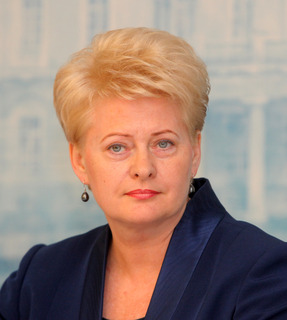 President of the Republic of Lithuania Dalia Grybauskaitė received letters of credence from the Ambassador of the United Arab Emirates, Mohammed Ahmed Al Mahmood.
more »
President of the Republic of Lithuania Dalia Grybauskaitė received letters of credence from the Ambassador of the United Arab Emirates, Mohammed Ahmed Al Mahmood.
more »
 As a response to the address made by representatives of Lithuania's culture community and civic society concerning the future of Kristijonas Donelaitis museum in Chistye Prudy in the Kaliningrad Oblast, President of the Republic of Lithuania D. Grybauskaitė sent a letter to President D. Medvedev of the Russian Federation.
more »
As a response to the address made by representatives of Lithuania's culture community and civic society concerning the future of Kristijonas Donelaitis museum in Chistye Prudy in the Kaliningrad Oblast, President of the Republic of Lithuania D. Grybauskaitė sent a letter to President D. Medvedev of the Russian Federation.
more »