WESTERN SUPPORT FOR BALTIC MEMBERSHIP IN NATO INCREASES
Published:
20 October 2001 y., Saturday
Some Western commentators have expressed concern that Russia's inclusion within the international coalition against terrorism will lead to it demanding concessions from the U.S. in areas such as NATO enlargement. These fears seem to be increasingly unwarranted as the range of Western countries that have voiced their support for the inclusion of the Baltic states continues to grow. There are even indications that Russian President Vladimir Putin may be withdrawing his "red line" to the CIS, which would no longer include the Baltic states within its sphere of influence.
At that meeting, the representatives of the three Baltic states drafted a position statement that argued that at the summit scheduled for November 2002 in Prague NATO should invite all nine aspirant states to join at the same time and not individually.
The Baltic republics initially looked to the U.S., Scandinavian countries, and Central European NATO members Poland, the Czech Republic, and Hungary as their main supporters in their bid for NATO membership. On recent visits to the Baltic states, Polish President Aleksandr Kwasniewski and Polish Foreign Minister Wladyslaw Bartoszewski both came out strongly in favor of Baltic membership. These views were also expressed by Hungarian Defense Minister Janos Szabo to the Hungarian parliament earlier this month.
Scandinavia has been at the forefront of promoting the Baltic states within NATO. At a Helsinki summit in August, Foreign Ministers from Denmark, Norway, Iceland, Sweden, and Finland expressed their firm support for the Balts to be included within NATO.
Support within NATO has expanded beyond the Central Europe and Scandinavia. Then-Turkish President Suleyman Demirel told his visiting Estonian counterpart as early as October 1998 that he rejected any Russian veto over NATO enlargement and therefore, "I have supported Estonia's wish to become a full member of NATO."
Germany and France initially expressed Russophile views that argued against Baltic membership. German officials reiterated that Russian "consent" would be required for further NATO enlargement, a statement in clear contradiction of NATO's "open door" policy. The German position has gradually evolved into cautious support, and France too now officially supports Baltic membership in NATO.
Šaltinis:
rferl.org
Copying, publishing, announcing any information from the News.lt portal without written permission of News.lt editorial office is prohibited.
The most popular articles
 President of the Republic of Lithuania Valdas Adamkus participated in the opening session of the Organisation for Security and Co-operation in Europe (OSCE) Parliamentary Assembly.
more »
President of the Republic of Lithuania Valdas Adamkus participated in the opening session of the Organisation for Security and Co-operation in Europe (OSCE) Parliamentary Assembly.
more »
 President Valdas Adamkus visited the Ministry of Foreign Affairs to bid farewell to its leadership and diplomatic corps.
more »
President Valdas Adamkus visited the Ministry of Foreign Affairs to bid farewell to its leadership and diplomatic corps.
more »
 June 22, Monday, President Valdas Adamkus is leaving for a working visit to Georgia.
more »
June 22, Monday, President Valdas Adamkus is leaving for a working visit to Georgia.
more »
 On Wednesday, Prime Minister Andrius Kubilius and his Baltic counterparts met with President of the European Commission José Manuel Barroso.
more »
On Wednesday, Prime Minister Andrius Kubilius and his Baltic counterparts met with President of the European Commission José Manuel Barroso.
more »
 This Thursday, June 18, President of the Republic of Lithuania Valdas Adamkus goes on a two-day working visit to Brussels, Belgium, to attend the European Council meeting.
more »
This Thursday, June 18, President of the Republic of Lithuania Valdas Adamkus goes on a two-day working visit to Brussels, Belgium, to attend the European Council meeting.
more »
 Lithuania has successfully tapped international financial markets with a 500-million euro benchmark eurobond transaction due 2014, with an annual coupon of 9.375 percent.
more »
Lithuania has successfully tapped international financial markets with a 500-million euro benchmark eurobond transaction due 2014, with an annual coupon of 9.375 percent.
more »
 July 6 will see a number of events dedicated to the Millennium of the Name of Lithuania.
more »
July 6 will see a number of events dedicated to the Millennium of the Name of Lithuania.
more »
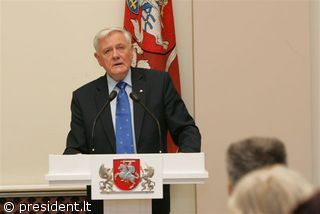 President of the Republic of Lithuania Valdas Adamkus attended the Swedish Business Awards 2009 Ceremony.
more »
President of the Republic of Lithuania Valdas Adamkus attended the Swedish Business Awards 2009 Ceremony.
more »
 President of the Republic of Lithuania Valdas Adamkus received Minister of Defence of the Federal Republic of Germany, Mr. Franz Josef Jung.
more »
President of the Republic of Lithuania Valdas Adamkus received Minister of Defence of the Federal Republic of Germany, Mr. Franz Josef Jung.
more »
President of the Republic of Lithuania Valdas Adamkus attended a reception as part of the international conference „The World Forum for Direct Investment 2009".
more »