Diplomats Look to Cold War Tactics for Help in Arab World
Published:
22 June 2004 y., Tuesday
The War on Terror frequently has been described as a battle for hearts and minds, but critics of American diplomatic efforts toward the Arab world say that not enough is being done and warn that losing the struggle would be disastrous to the United States.
Aside from military might, the United States has started fighting the seeds of terror through public outreach that includes the establishment of Arabic-language media outlets, among other projects. But all polling data so far indicate the United States is far from victorious when it comes to earning the trust and friendship of Arab countries.
Polls show plunging American popularity throughout the world, with numbers registering the lowest in the Middle East. A Pew Global Attitudes survey released in March showed an overwhelmingly unfavorable view of the United States among respondents in all four Muslim countries surveyed — Turkey, Pakistan, Jordan and Morocco. In Morocco, Jordan and Pakistan, Usama bin Laden is far more popular than President Bush.
The numbers have only gotten worse since the Abu Ghraib prison abuse scandal.
"The public diplomacy we currently have is not working," Rep. Frank Wolf, R-Va., told an audience at the American Enterprise Institute earlier this month. "With what's taking place in the prisons in Iraq, I think it is much more difficult."
But directors and managers of American-funded Arabic-language TV and radio stations say they will continue to soldier on and get the U.S. message across.
Šaltinis:
.foxnews.com
Copying, publishing, announcing any information from the News.lt portal without written permission of News.lt editorial office is prohibited.
The most popular articles
 On 28 July at the square in front of the Ministry of National Defence the solemn initiation ceremony of the assigning of the Chief of Defence of the Republic of Lithuania was held.
more »
On 28 July at the square in front of the Ministry of National Defence the solemn initiation ceremony of the assigning of the Chief of Defence of the Republic of Lithuania was held.
more »
 On 28 July, Lithuania’s Minister of Foreign Affairs Vygaudas Ušackas met with Minister of Foreign Affairs of Bosnia and Herzegovina Sven Alkalaj, who was paying an official visit to Lithuania.
more »
On 28 July, Lithuania’s Minister of Foreign Affairs Vygaudas Ušackas met with Minister of Foreign Affairs of Bosnia and Herzegovina Sven Alkalaj, who was paying an official visit to Lithuania.
more »
 Lithuanian Minister of National Defence and Estonian Defence Minister by phone discussed readiness of Baltic Battalion to be on duty in NATO Response Force after the information that due to extremely difficult economic situation Latvia will decrease its input into the battalion.
more »
Lithuanian Minister of National Defence and Estonian Defence Minister by phone discussed readiness of Baltic Battalion to be on duty in NATO Response Force after the information that due to extremely difficult economic situation Latvia will decrease its input into the battalion.
more »
 In the evening of 27 July in Brussels at the end of the EU foreign ministers’ meeting and before the EU-Belarus consultations, Lithuania’s Minister of Foreign Affairs V. Ušackas met with Minister of Foreign Affairs of Belarus S. Martynov.
more »
In the evening of 27 July in Brussels at the end of the EU foreign ministers’ meeting and before the EU-Belarus consultations, Lithuania’s Minister of Foreign Affairs V. Ušackas met with Minister of Foreign Affairs of Belarus S. Martynov.
more »
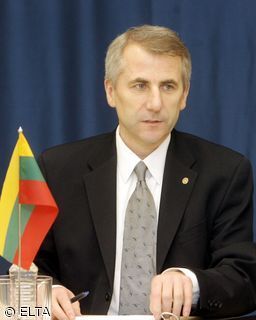 On 27 July in Brussels, Lithuania’s Minister of Foreign Affairs Vygaudas Ušackas and EU Foreign Ministers discussed the situation in Georgia and its neighbourhood.
more »
On 27 July in Brussels, Lithuania’s Minister of Foreign Affairs Vygaudas Ušackas and EU Foreign Ministers discussed the situation in Georgia and its neighbourhood.
more »
 Lithuania’s Minister of Foreign Affairs Vygaudas Ušackas met with Iceland’s Minister for Foreign Affairs Össur Skarphedinsson, Minister of Social Affairs and Social Security Árni Páll Árnason and Chairman of the Parliamentary Committee on Foreign Affairs Árni Thór Sigurdsson.
more »
Lithuania’s Minister of Foreign Affairs Vygaudas Ušackas met with Iceland’s Minister for Foreign Affairs Össur Skarphedinsson, Minister of Social Affairs and Social Security Árni Páll Árnason and Chairman of the Parliamentary Committee on Foreign Affairs Árni Thór Sigurdsson.
more »
 President Dalia Grybauskaitė received the Apostolic Nuncio to Lithuania, Archbishop Luigi Bonazzi.
more »
President Dalia Grybauskaitė received the Apostolic Nuncio to Lithuania, Archbishop Luigi Bonazzi.
more »
 On 23 July in Stockholm, Vice-Minister of Foreign Affairs of Lithuania Asta Skaisgirytė Liauškienė and Swedish Minister for European Affairs Cecilia Malmström discussed priorities of Sweden’s EU Presidency.
more »
On 23 July in Stockholm, Vice-Minister of Foreign Affairs of Lithuania Asta Skaisgirytė Liauškienė and Swedish Minister for European Affairs Cecilia Malmström discussed priorities of Sweden’s EU Presidency.
more »
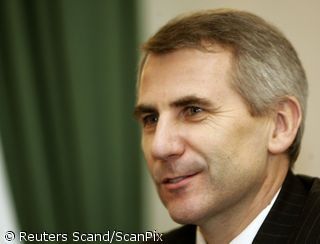 Lithuania’s Acting Minister of Foreign Affairs V. Ušackas had a telephone conversation with Iceland’s Minister for Foreign Affairs Össur Skarphedinsson, during which the Ministers discussed Iceland’s decision to apply for the European Union membership.
more »
Lithuania’s Acting Minister of Foreign Affairs V. Ušackas had a telephone conversation with Iceland’s Minister for Foreign Affairs Össur Skarphedinsson, during which the Ministers discussed Iceland’s decision to apply for the European Union membership.
more »
 Acting in conformity the Constitution of Lithuania and based on the proposal submitted by Prime Minister Andrius Kubilius, President D. Grybauskaitė has approved the Government of the Republic of Lithuania.
more »
Acting in conformity the Constitution of Lithuania and based on the proposal submitted by Prime Minister Andrius Kubilius, President D. Grybauskaitė has approved the Government of the Republic of Lithuania.
more »