Russian Defence Minister Says Moscow Likely to Seek Renegotiation of Istanbul Agreements
Published:
15 February 2004 y., Sunday
Russia is likely to denounce the Istanbul agreements, particularly the Conventional Forces in Europe (CFE) treaty and seek renegotiation of the deadlines for its military withdrawal from Georgia and Moldova, Russian Defence Minister Sergey Ivanov was quoted as saying by The Financial Times and The New York Times on Sunday and Monday at the 40th NATO annual conference on security and defence issues in Munchen.
According to Ivanov, "today, the so-called Istanbul political commitments are alleged to be a 'stumbling block' for the ratification despite the fact that these commitments have nothing to do with the Treaty..."
"At least, one thing is clear for us: the CFE regime in its actual form can not go on uphold stability and balance of interests of the signatory States amid actual military and political developments in Europe. Admission to the NATO of seven new members, with four of them staying out of the Treaty, finally makes the Treaty System of limitations imperfect, under-efficient, and cut off from the realities," the reports said.
In the context, the Russian defence chief noted that relationship with close neighbours is one of basic priorities of Russia's foreign policy. "Relationship with the CIS members cannot be treated as a typical feature of Russian-style 'neo-imperialism', the way some people try to do. These relations are compulsory for our security," Ivanov underlined.
According to western reports, Senator John McCain, a Republican, was one of the few top U.S. officials at the conference to accuse Russian President Vladimir Putin of conspiracy against Russian democracy, as well as of start of a campaign of intimidation and restoration of control on states which withdrew from Soviet domination.
Šaltinis:
BASA-PRESS
Copying, publishing, announcing any information from the News.lt portal without written permission of News.lt editorial office is prohibited.
The most popular articles
 On 26 November, Lithuania’s Minister of Foreign Affairs Vygaudas Ušackas delivered a lecture “The New NATO Strategic Concept: Lithuania’s Vision” to the participants of Higher Command Studies Course of the Baltic Defence College (BALTDEFCOL).
more »
On 26 November, Lithuania’s Minister of Foreign Affairs Vygaudas Ušackas delivered a lecture “The New NATO Strategic Concept: Lithuania’s Vision” to the participants of Higher Command Studies Course of the Baltic Defence College (BALTDEFCOL).
more »
 On 25 November at the European Information Bureau of the Seimas, Lithuania’s Minister of Foreign Affairs Vygaudas Ušackas took part in the round table discussion “Climate Change: from Kyoto to Copenhagen” and spoke about Lithuania’s contribution to combating climate change.
more »
On 25 November at the European Information Bureau of the Seimas, Lithuania’s Minister of Foreign Affairs Vygaudas Ušackas took part in the round table discussion “Climate Change: from Kyoto to Copenhagen” and spoke about Lithuania’s contribution to combating climate change.
more »
 President of the Republic of Lithuania Dalia Grybauskaitė goes for a working visit to Ukraine to attend a session of the Council of Presidents of the Republic of Lithuania and Ukraine and to meet with Ukraine's President Viktor Yushchenko.
more »
President of the Republic of Lithuania Dalia Grybauskaitė goes for a working visit to Ukraine to attend a session of the Council of Presidents of the Republic of Lithuania and Ukraine and to meet with Ukraine's President Viktor Yushchenko.
more »
 Today, November 26, meeting of the Baltic Chiefs of Defence will begin in General Adolfas Ramanauskas Warfare Training Centre in Nemenčinė (Vilnius distr.).
more »
Today, November 26, meeting of the Baltic Chiefs of Defence will begin in General Adolfas Ramanauskas Warfare Training Centre in Nemenčinė (Vilnius distr.).
more »
 November 24, Defence Attachés accredited to Lithuania met at MoND to address international defence cooperation of Lithuania, activities and plans of the Lithuanian-led Chaghcharan PRT.
more »
November 24, Defence Attachés accredited to Lithuania met at MoND to address international defence cooperation of Lithuania, activities and plans of the Lithuanian-led Chaghcharan PRT.
more »
 President Dalia Grybauskaitė extended congratulations to President Mikheil Saakashvili of Georgia on the occasion of national holiday.
more »
President Dalia Grybauskaitė extended congratulations to President Mikheil Saakashvili of Georgia on the occasion of national holiday.
more »
 This year marks the 20th anniversary of the collapse of communism in Europe and the end of the Cold War.
more »
This year marks the 20th anniversary of the collapse of communism in Europe and the end of the Cold War.
more »
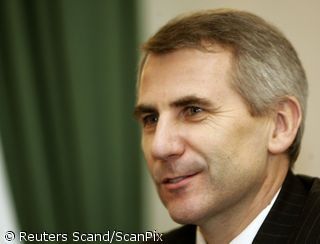 Today Lithuania‘s Minister of Foreign Affairs Vygaudas Ušackas is starting his official visit to Armenia where he will meet with the highest ranking officials of the state, as well as with the representatives of the international organizations and local authorities.
more »
Today Lithuania‘s Minister of Foreign Affairs Vygaudas Ušackas is starting his official visit to Armenia where he will meet with the highest ranking officials of the state, as well as with the representatives of the international organizations and local authorities.
more »
 On 20 November, Lithuania’s Minister of Foreign Affairs Vygaudas Ušackas congratulated Catherine Ashton who had just been elected as European Union‘s High Representative for Foreign Affairs and Security Policy.
more »
On 20 November, Lithuania’s Minister of Foreign Affairs Vygaudas Ušackas congratulated Catherine Ashton who had just been elected as European Union‘s High Representative for Foreign Affairs and Security Policy.
more »
 On 20 November, Lithuania’s Ministry of Foreign Affairs in cooperation with the Lithuanian business confederation | ICC Lithuania will host a seminar “Business in sub-Saharan Africa: Possibilities and Challenges”.
more »
On 20 November, Lithuania’s Ministry of Foreign Affairs in cooperation with the Lithuanian business confederation | ICC Lithuania will host a seminar “Business in sub-Saharan Africa: Possibilities and Challenges”.
more »