Shock swing towards euroscepticism in European Parliament elections
Published:
14 June 2004 y., Monday
With most of the results counted, it is clear that smaller, eurosceptic or populist parties have triumphed at the expense of more well-established parties.
The biggest shock for the establishment undoubtedly comes from the UK, where the United Kingdom Independence Party (UKIP), which wants complete withdrawal from the EU, looks to have secured 20 percent of the vote and 17 seats.
This result would place the UKIP third behind the Conservatives (polling 22 percent at the time of writing) and Labour (also on 22 percent).
And it would leave the more established Liberal Democrats trailing in their wake on 14 percent. Liberal leader Graham Watson said he regretted the fact that "parliament will have a greater number of anti-Europeans" adding that they will be rather "unproductive members".
Pat Cox, outgoing head of the European Parliament, put a brave face on the result by saying that "though significant and a new dimension in its scale, it must be put in context". He said it only represented 10-15% of MEPs.
Eurosceptics also achieved a major victory in Sweden, where the recently-formed EU-critical Junilistan came third in the election, securing 14.4 percent of the vote and three seats in the new European Parliament.
It was also a memorable night for the populist Vlaams Blok in Belgium. The far-right party scored 14.3 percent (at the time of writing), making it the second biggest party in Belgium.
Šaltinis:
EUOBSERVER
Copying, publishing, announcing any information from the News.lt portal without written permission of News.lt editorial office is prohibited.
The most popular articles
 September 6, literacy courses for local residents were formally opened in the UN Representation in Chaghcharan, capital of province of Ghowr.
more »
September 6, literacy courses for local residents were formally opened in the UN Representation in Chaghcharan, capital of province of Ghowr.
more »
 Lithuania’s Minister of Foreign Affairs Vygaudas Ušackas and Italy’s Minister of Foreign Affairs Franco Frattini discussed perspectives of developing a bilateral dialogue, intensifying economic cooperation, etc.
more »
Lithuania’s Minister of Foreign Affairs Vygaudas Ušackas and Italy’s Minister of Foreign Affairs Franco Frattini discussed perspectives of developing a bilateral dialogue, intensifying economic cooperation, etc.
more »
 During the informal meeting of European Union’s foreign ministers on 4-5 September in Stockholm, Lithuania’s Minister of Foreign Affairs Vygaudas Ušackas and his counterparts discussed the issues of Afghanistan, relations with Iran...
more »
During the informal meeting of European Union’s foreign ministers on 4-5 September in Stockholm, Lithuania’s Minister of Foreign Affairs Vygaudas Ušackas and his counterparts discussed the issues of Afghanistan, relations with Iran...
more »
 On 3 September in Vilnius, Lithuania’s Minister of Foreign Affairs V. Ušackas met with Vice-President of the European Commission G. Verheugen, responsible for enterprise and industry, and discussed the most important issues of economy, energy and the implementation of the Treaty of Lisbon.
more »
On 3 September in Vilnius, Lithuania’s Minister of Foreign Affairs V. Ušackas met with Vice-President of the European Commission G. Verheugen, responsible for enterprise and industry, and discussed the most important issues of economy, energy and the implementation of the Treaty of Lisbon.
more »
 On 22 July, the Government approved of the amendments to the Labour Code proposed by the Ministry of Social Security and Labour.
more »
On 22 July, the Government approved of the amendments to the Labour Code proposed by the Ministry of Social Security and Labour.
more »
 Lithuania’s Minister of Foreign Affairs V. Ušackas discussed the problems of Lithuanian carriers while crossing the Russian border with Igor Levitin, Minister of Transport of the Russian Federation and co-chairman of the Lithuanian-Russian intergovernmental commission.
more »
Lithuania’s Minister of Foreign Affairs V. Ušackas discussed the problems of Lithuanian carriers while crossing the Russian border with Igor Levitin, Minister of Transport of the Russian Federation and co-chairman of the Lithuanian-Russian intergovernmental commission.
more »
 Lithuania‘s Minister of Foreign Affairs welcomed the decision of the new NATO Secretary General Anders Fogh Rasmussen to include a joint representative of the Baltic States into a group of experts which is tasked to prepare a new Strategic Concept of NATO.
more »
Lithuania‘s Minister of Foreign Affairs welcomed the decision of the new NATO Secretary General Anders Fogh Rasmussen to include a joint representative of the Baltic States into a group of experts which is tasked to prepare a new Strategic Concept of NATO.
more »
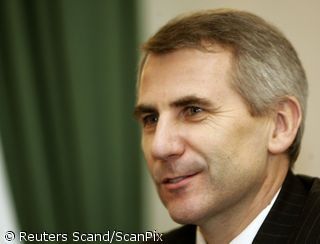 On 3 August, Lithuania’s Minister of Foreign Affairs Vygaudas Ušackas met with Serbia’s Foreign Minister Vuk Jeremić, who was paying a visit to Lithuania.
more »
On 3 August, Lithuania’s Minister of Foreign Affairs Vygaudas Ušackas met with Serbia’s Foreign Minister Vuk Jeremić, who was paying a visit to Lithuania.
more »
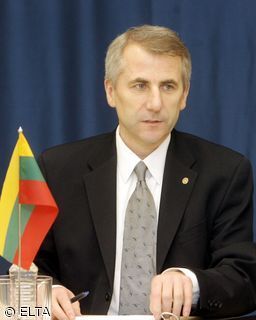 On 30 July, Lithuania’s Minister of Foreign Affairs Vygaudas Ušackas bade farewell to outgoing Ambassador of Belgium to Lithuania Filip Cumps and thanked him for his input into fostering bilateral relations.
more »
On 30 July, Lithuania’s Minister of Foreign Affairs Vygaudas Ušackas bade farewell to outgoing Ambassador of Belgium to Lithuania Filip Cumps and thanked him for his input into fostering bilateral relations.
more »
 On 29 July farewell ceremony with the departing Canadian Defence Attaché for Lithuania Jim Petryk was held in the Ministry of National Defence.
more »
On 29 July farewell ceremony with the departing Canadian Defence Attaché for Lithuania Jim Petryk was held in the Ministry of National Defence.
more »