Pentagon wants to avoid misunderstandings over nuclear weapons related to millennium bug.
Published:
23 July 1999 y., Friday
The United States has again asked Russia to join in minimizing the risk of a missile-launch misunderstanding at the height of Year 2000 computer uncertainties, the U.S. Defense Department said Tuesday. Moscow has not yet replied to the latest U.S. overture, said a Pentagon spokesman. At issue is a proposed temporary "early warning" center that would keep missile-launching commanders constantly aware of what the other side was seeing and doing during the potentially troublesome date rollover. Simulations have shown that older computers and microchips could crash or malfunction by misreading the year 2000 as 1900, the result of an old programming shortcut based on a two-digit date field. A facility designed to be shared with Russia to head off any false alerts has already been set up by the United States at Peterson Air Force Base, near Colorado Springs, Colo. President Clinton and Russian President Boris Yeltsin set the project in motion when they met in Moscow last September as part of a post-Cold War plan to share early warning data about long-range missile launches. Before the bombing of Serbia drove U.S.-Russian ties to their lowest ebb of the post-Cold War period, the United States and Russia had been talking regularly about 2000-related computer issues. Pentagon officials say they are fully confident, based on extensive testing, that critical systems in the U.S. nuclear chain of command will work flawlessly during the date change. They also say they see virtually no possibility of accidental launches because humans must make final decisions in both countries.
Šaltinis:
Internet
Copying, publishing, announcing any information from the News.lt portal without written permission of News.lt editorial office is prohibited.
The most popular articles
 On 26 November, Lithuania’s Minister of Foreign Affairs Vygaudas Ušackas delivered a lecture “The New NATO Strategic Concept: Lithuania’s Vision” to the participants of Higher Command Studies Course of the Baltic Defence College (BALTDEFCOL).
more »
On 26 November, Lithuania’s Minister of Foreign Affairs Vygaudas Ušackas delivered a lecture “The New NATO Strategic Concept: Lithuania’s Vision” to the participants of Higher Command Studies Course of the Baltic Defence College (BALTDEFCOL).
more »
 On 25 November at the European Information Bureau of the Seimas, Lithuania’s Minister of Foreign Affairs Vygaudas Ušackas took part in the round table discussion “Climate Change: from Kyoto to Copenhagen” and spoke about Lithuania’s contribution to combating climate change.
more »
On 25 November at the European Information Bureau of the Seimas, Lithuania’s Minister of Foreign Affairs Vygaudas Ušackas took part in the round table discussion “Climate Change: from Kyoto to Copenhagen” and spoke about Lithuania’s contribution to combating climate change.
more »
 President of the Republic of Lithuania Dalia Grybauskaitė goes for a working visit to Ukraine to attend a session of the Council of Presidents of the Republic of Lithuania and Ukraine and to meet with Ukraine's President Viktor Yushchenko.
more »
President of the Republic of Lithuania Dalia Grybauskaitė goes for a working visit to Ukraine to attend a session of the Council of Presidents of the Republic of Lithuania and Ukraine and to meet with Ukraine's President Viktor Yushchenko.
more »
 Today, November 26, meeting of the Baltic Chiefs of Defence will begin in General Adolfas Ramanauskas Warfare Training Centre in Nemenčinė (Vilnius distr.).
more »
Today, November 26, meeting of the Baltic Chiefs of Defence will begin in General Adolfas Ramanauskas Warfare Training Centre in Nemenčinė (Vilnius distr.).
more »
 November 24, Defence Attachés accredited to Lithuania met at MoND to address international defence cooperation of Lithuania, activities and plans of the Lithuanian-led Chaghcharan PRT.
more »
November 24, Defence Attachés accredited to Lithuania met at MoND to address international defence cooperation of Lithuania, activities and plans of the Lithuanian-led Chaghcharan PRT.
more »
 President Dalia Grybauskaitė extended congratulations to President Mikheil Saakashvili of Georgia on the occasion of national holiday.
more »
President Dalia Grybauskaitė extended congratulations to President Mikheil Saakashvili of Georgia on the occasion of national holiday.
more »
 This year marks the 20th anniversary of the collapse of communism in Europe and the end of the Cold War.
more »
This year marks the 20th anniversary of the collapse of communism in Europe and the end of the Cold War.
more »
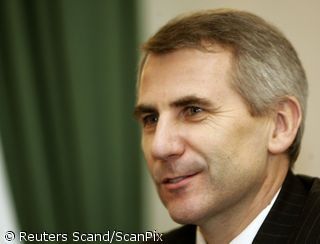 Today Lithuania‘s Minister of Foreign Affairs Vygaudas Ušackas is starting his official visit to Armenia where he will meet with the highest ranking officials of the state, as well as with the representatives of the international organizations and local authorities.
more »
Today Lithuania‘s Minister of Foreign Affairs Vygaudas Ušackas is starting his official visit to Armenia where he will meet with the highest ranking officials of the state, as well as with the representatives of the international organizations and local authorities.
more »
 On 20 November, Lithuania’s Minister of Foreign Affairs Vygaudas Ušackas congratulated Catherine Ashton who had just been elected as European Union‘s High Representative for Foreign Affairs and Security Policy.
more »
On 20 November, Lithuania’s Minister of Foreign Affairs Vygaudas Ušackas congratulated Catherine Ashton who had just been elected as European Union‘s High Representative for Foreign Affairs and Security Policy.
more »
 On 20 November, Lithuania’s Ministry of Foreign Affairs in cooperation with the Lithuanian business confederation | ICC Lithuania will host a seminar “Business in sub-Saharan Africa: Possibilities and Challenges”.
more »
On 20 November, Lithuania’s Ministry of Foreign Affairs in cooperation with the Lithuanian business confederation | ICC Lithuania will host a seminar “Business in sub-Saharan Africa: Possibilities and Challenges”.
more »