The Organization for Security and Cooperation in Europe said on November 23 that it has fulfilled its mission in Estonia and now wants to close its doors after an eight-year presence here.
Published:
30 November 2001 y., Friday
The move was seen by many Estonians as final confirmation of its pro-West, democratic credentials.
Concerns raised in Russia about Estonia's Russian minority led to an OCSE office being set up two years after the Soviet occupation ended in 1991--though some Estonians grumbled the OSCE presence was politically motivated, unnecessary and an affront.
But Tallinn-based officials of the leading human rights oversight group said a language requirement for candidates running for elected office had been its last major bone of contention. Estonia's parliament canceled that provision a day before, on November 21.
Harri Tiido, deputy undersecretary at Estonia's Foreign Ministry, welcomed the OSCE moves to close its office, adding that "we've done all we've been asked to do and there is nothing else the OSCE has asked—so their mandate's fulfilled"
Russia expressed particular anger at Estonian language laws—which it argued disenfranchise Russian-speakers, mostly ethnic Russians who moved here during the Soviet occupation and now make up 40 percent of the 1.4 million population. The issue soured bilateral relations.
Estonia said its language laws met international norms and were meant to counteract five decades of repressive Soviet policies which often favored Russian over native Estonian, a vowel-laden language closely related to Finnish and spoken by barely one million people.
But over the years Estonia soften the laws, culminating in the cancellation of the rule that those running for office be able to speak Estonian. Critics said it discriminated against Russian speakers—most of whom speak little or no Estonian.
Šaltinis:
balticsww.com
Copying, publishing, announcing any information from the News.lt portal without written permission of News.lt editorial office is prohibited.
The most popular articles
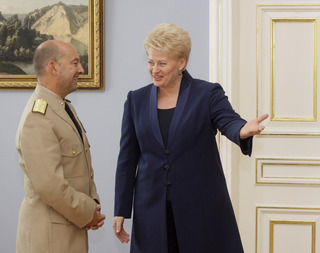 The President of the Republic of Lithuania, Dalia Grybauskaitė, met with the Commander of the US European Command and NATO's Supreme Allied Commander Europe, Admiral James G. Stavridis.
more »
The President of the Republic of Lithuania, Dalia Grybauskaitė, met with the Commander of the US European Command and NATO's Supreme Allied Commander Europe, Admiral James G. Stavridis.
more »
 The President of the Republic of Lithuania, Dalia Grybauskaitė, met with the Prime Minister of Estonia, Andrus Ansip, who is on a visit to Lithuania.
more »
The President of the Republic of Lithuania, Dalia Grybauskaitė, met with the Prime Minister of Estonia, Andrus Ansip, who is on a visit to Lithuania.
more »
 July 12 marks one year since President Dalia Grybauskaitė took office. What has changed in Lithuania over that time?
more »
July 12 marks one year since President Dalia Grybauskaitė took office. What has changed in Lithuania over that time?
more »
 On 8-9 July in Genval, Belgium, Political Director of Lithuania’s Ministry of Foreign Affairs Eitvydas Bajarūnas took part in the consultations of political directors from foreign ministries of 27 European Union member states.
more »
On 8-9 July in Genval, Belgium, Political Director of Lithuania’s Ministry of Foreign Affairs Eitvydas Bajarūnas took part in the consultations of political directors from foreign ministries of 27 European Union member states.
more »
 On 9 July, Lithuania’s Minister of Foreign Affairs Audronius Ažubalis received the outgoing Ambassador of Ukraine Ihor Prokopchuk.
more »
On 9 July, Lithuania’s Minister of Foreign Affairs Audronius Ažubalis received the outgoing Ambassador of Ukraine Ihor Prokopchuk.
more »
 On 7 July in Vilnius, Lithuania’s Minister of Foreign Affairs Audronius Ažubalis and Israel’s Foreign Minister Avigdor Liberman discussed bilateral political, economic and cultural cooperation, as well as possibilities to intensify economic, trade and tourist exchanges.
more »
On 7 July in Vilnius, Lithuania’s Minister of Foreign Affairs Audronius Ažubalis and Israel’s Foreign Minister Avigdor Liberman discussed bilateral political, economic and cultural cooperation, as well as possibilities to intensify economic, trade and tourist exchanges.
more »
 In the statement by U.S. President Barack Obama on the 10th Anniversary of the Community of Democracies that was released on 3 July, the President commended Lithuania for its Presidency of the Community and efforts to focus on the pressing challenges of today.
more »
In the statement by U.S. President Barack Obama on the 10th Anniversary of the Community of Democracies that was released on 3 July, the President commended Lithuania for its Presidency of the Community and efforts to focus on the pressing challenges of today.
more »
 "You offer us yet another opportunity to put ourselves and our civic mind to the test of time. Your example makes us raise our standards higher and higher," President of the Republic of Lithuania Dalia Grybauskaitė said at the ceremony of presenting state awards.
more »
"You offer us yet another opportunity to put ourselves and our civic mind to the test of time. Your example makes us raise our standards higher and higher," President of the Republic of Lithuania Dalia Grybauskaitė said at the ceremony of presenting state awards.
more »
 President Dalia Grybauskaitė offered personal congratulations by phone to President-elect Bronisław Komorowski on his victory in Poland's presidential elections.
more »
President Dalia Grybauskaitė offered personal congratulations by phone to President-elect Bronisław Komorowski on his victory in Poland's presidential elections.
more »
 Foreign states and international organizations extend condolences to Lithuania on the passing of President Algirdas Mykolas Brazauskas
more »
Foreign states and international organizations extend condolences to Lithuania on the passing of President Algirdas Mykolas Brazauskas
more »