Serb opposition politician Zoran Djindjic said in a Russian television interview broadcast on Friday that opponents of President Slobodan Milosevic would proceed with mass protests later this month.
Published:
20 March 2000 y., Monday
"We are indeed starting a serious civil campaign to secure new elections and change in Serbia. The authorities are not allowing the necessary changes to go ahead," Djinjic said in an interview broadcast on ORT public television.
"We are one of the most isolated countries in the world. Our government cannot rule the territory it has...We want faster change and we can help speed it up with protests and demonstrations." ORT said the interview, with Djindjic speaking by mobile telephone from Belgrade, had been conducted several days ago. It said Yugoslav authorities had tried to prevent the tape from being taken out of the country and that it could not reveal how and through whom the video material had reached Moscow.
Russian authorities have publicly supported Yugoslavia and defended Belgrade during the 11-week-long NATO air campaign against Yugoslav targets last year.
Though Moscow contributed more than 3,000 peacekeepers to the NATO-led KFOR operation in Kosovo, it has expressed anger at KFOR_s alleged failure to protect Kosovo_s Serb minority from attacks by majority ethnic Albanians.
Djindjic_s interview was broadcast as Serbian opposition politicians debated what action to take against the Belgrade government_s shutdown of four local radio stations and three television channels in the past 10 days. Leaders are due to meet next week to decide on concrete days for planned protests.
Copying, publishing, announcing any information from the News.lt portal without written permission of News.lt editorial office is prohibited.
The most popular articles
 Heads of foreign states bid farewell to the late President of the Republic of Lithuania, Algirdas Mykolas Brazauskas.
more »
Heads of foreign states bid farewell to the late President of the Republic of Lithuania, Algirdas Mykolas Brazauskas.
more »
 Today we say farewell to one of the most prominent Lithuanian politicians, a sincere and open person, a man of principle, Algirdas Brazauskas - the first directly elected president of Lithuania after re-independence.
more »
Today we say farewell to one of the most prominent Lithuanian politicians, a sincere and open person, a man of principle, Algirdas Brazauskas - the first directly elected president of Lithuania after re-independence.
more »
 Head of Cabinet of the Secretary General of the Council of the European Union Marek Mora is paying a visit to Lithuania from 30 June to 1 July.
more »
Head of Cabinet of the Secretary General of the Council of the European Union Marek Mora is paying a visit to Lithuania from 30 June to 1 July.
more »
 Lithuania‘s Minister of Foreign Affairs A. Ažubalis says, that continuous implementation of the Treaty of Lisbon, energy security, as well as European Union‘s relations with Eastern Neighbourhood countries and Russia would stay on the list of European policy issues that are the most important to Lithuania in the second half of 2010.
more »
Lithuania‘s Minister of Foreign Affairs A. Ažubalis says, that continuous implementation of the Treaty of Lisbon, energy security, as well as European Union‘s relations with Eastern Neighbourhood countries and Russia would stay on the list of European policy issues that are the most important to Lithuania in the second half of 2010.
more »
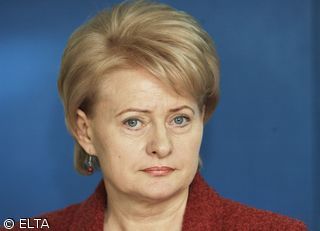 President of the Republic of Lithuania Dalia Grybauskaitė calls the decisions adopted by the European Council strategic and important for Lithuania and for the whole European Union.
more »
President of the Republic of Lithuania Dalia Grybauskaitė calls the decisions adopted by the European Council strategic and important for Lithuania and for the whole European Union.
more »
 On 16 June in Vilnius, Lithuania’s Minister of Foreign Affairs Audronius Ažubalis and Poland’s Minister of National Defence Bogdan Klich discussed successful bilateral cooperation on security and defence matters.
more »
On 16 June in Vilnius, Lithuania’s Minister of Foreign Affairs Audronius Ažubalis and Poland’s Minister of National Defence Bogdan Klich discussed successful bilateral cooperation on security and defence matters.
more »
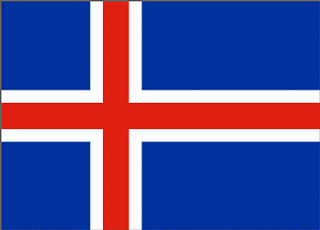 President of the Republic of Lithuania Dalia Grybauskaitė sent congratulations to President Ólafur Ragnar Grímsson of the Republic of Iceland on Iceland's national holiday, the Independence Day.
more »
President of the Republic of Lithuania Dalia Grybauskaitė sent congratulations to President Ólafur Ragnar Grímsson of the Republic of Iceland on Iceland's national holiday, the Independence Day.
more »
 President of the Republic of Lithuania Dalia Grybauskaitė goes on an official visit to the Grand Duchy of Luxembourg.
more »
President of the Republic of Lithuania Dalia Grybauskaitė goes on an official visit to the Grand Duchy of Luxembourg.
more »
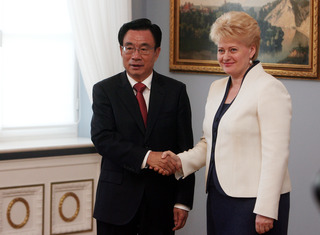 President of the Republic of Lithuania Dalia Grybauskaitė received a high-ranking government official from China, He Guoqiang.
more »
President of the Republic of Lithuania Dalia Grybauskaitė received a high-ranking government official from China, He Guoqiang.
more »
 On the occasion of European Day for Border Guards, the 10th of June, heads of diplomatic missions of the European Union member states in Lithuania visited the Border Guard School in Medininkai.
more »
On the occasion of European Day for Border Guards, the 10th of June, heads of diplomatic missions of the European Union member states in Lithuania visited the Border Guard School in Medininkai.
more »