Recent trends and changes in the industry have become key topics of discussion at the partner summit of Diebold Nixdorf, worldwide leader in banking and retail solutions.
 Electronic commerce makes significant changes to consumer habits, affecting retail as a whole. In the struggle for the customer, global retail becomes a competitive industry that seeks and implements innovations. However, new technologies relate not only to sales or customer service, but also to automatization, acceleration of trade internal processes.
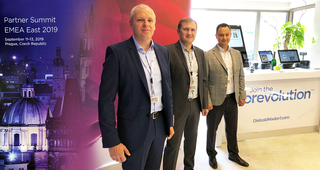
Recent trends and changes in the industry have become key topics of discussion at the partner summit of Diebold Nixdorf, worldwide leader in banking and retail solutions. On September 11-13, EMEA East partners were invited to the Czech capital, Prague. Representatives (in the photo: Kęstutis Andriuškevičius, Jurij Mikuckij, Emil Musayev) of Penkių kontinentų bankinės technologijos (BS/2), owned by Penki Kontinentai Group, also attended this event.
“For the first time, Diebold Nixdorf organized a summit for retail suppliers of innovative solutions. Earlier, the company held meetings of partners in both areas: banking and retail. The retail development and increased competition caused a separate event. This meeting with partners gave us the opportunity to get acquainted with new solutions and share practical experience,” says Emil Musayev, Head of BS/2 Retail Department.
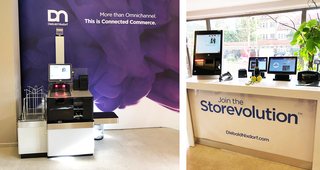 During the three-day summit, Diebold Nixdorf speakers made presentations on modern self-service systems, cash management and payment solutions. Cost reduction, operational efficiency and the collection of customer information remain the main goals of trade organizations. The partner companies were introduced to the competitive advantages of the DN Vynamic ™ Retail Software Suit, designed specifically for retail transformation. The solution integrates all installed systems into a single network for the implementation of omnichannel at all levels of the business.
“The modern retail realities are consumer migration between the physical and digital worlds, as well as the convergence of banking and retail services. Connected Commerce ensures the availability of financial and retail services anywhere, anytime, in any format familiar to the client,” says E. Musayev.
The summit program was supplemented by technology partners’ presentations, including Zebra Technologies, YourPass, AEVI, Yieldigo, InPost.
Collaboration with other companies allows Diebold Nixdorf to maintain feedback and develop innovative technologies for each stage of the purchasing path.