Quantum dots with built-in charge boost solar cell efficiency by 50%

Published: 16 May 2011 y., Monday

For the past few years, researchers have been using quantum dots to increase the light absorption and overall efficiency of solar cells. 
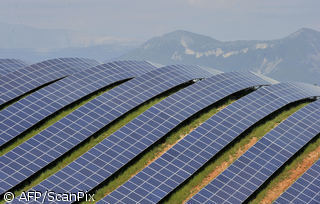
The researchers, Kimberly Sablon and John W. Little (US Army Research Laboratory in Adelphi, Maryland), Vladimir Mitin, Andrei Sergeev, and Nizami Vagidov (University of Buffalo in Buffalo, New York), and Kitt Reinhardt (AFOSR/NE in Arlington, Virginia) have published their study on the increased solar cell efficiency in a recent issue of Nano Letters.

In their study, the researchers studied heterostructure solar cells with InAs/GaAs quantum dots. As photovoltaic materials, the quantum dots allow for harvesting of the infrared radiation to convert it into electric energy. However, the quantum dots also enhance the recombination of photocarriers and decrease the photocurrent. For this reason, up to now the improvement of photovoltaic efficiency due to quantum dots has been limited by several percent.

Here, the researchers have proposed to charge quantum dots by using selective interdot doping. In their experiments, the researchers compared doping levels of 2, 3, and 6 additional electrons per quantum dot, which resulted in photovoltaic efficiency increases of 4.5%, 30%, and 50%, respectively, compared to an undoped solar cell. For the 6-electron doping level, that 50% increase corresponds to an overall efficiency increase from 9.3% (for undoped solar cells) to 14%.

The researchers attributed this radical improvement of the photovoltaic efficiency to two basic effects. First, the built-in-dot charge induces various transitions of the electrons and enhances harvesting of the infrared radiation. Second, the built-in-dot charge creates potential barriers around dots and these barriers suppress capture processes for electrons and do not allow them to return back into the dots.

In addition, the researchers predict that further increasing the doping level will lead to an even stronger efficiency enhancement, since there was no evidence of saturation. In the future, the researchers plan to further investigate how these effects influence each other at higher doping levels. They predict that further increasing the doping level and radiation intensity will lead to an even stronger efficiency enhancement, since there was no evidence of saturation.

Šaltinis: physorg.com
Copying, publishing, announcing any information from the News.lt portal without written permission of News.lt editorial office is prohibited.

Facebook Comments

New comment


Captcha

Associated articles

European Earth Observation Programme under scrutiny

A European monitoring system that can detect floods and help target help in natural disasters like in Haiti is being discussed by MEPs. more »

Haiti Damage and Needs Assessment: World Bank Partners with Global Network of Scientists and Experts

The World Bank, supported by the Global Facility for Disaster Reduction and Recovery (GFDRR), announced today that it has mobilized scientists and technical experts around the world to help assess the impacts of the earthquake in Haiti. more »

The Spanish Presidency is committed to putting education “at the heart” of the 2020 Strategy

The Spanish Minister of Education, Ángel Gabilondo, speaking in the Culture, Education and Youth Committee of the European Parliament, insisted on the importance of strengthening the idea of a Social Europe by means of a new link between the economy and education, one of the basic pillars of the Spanish Presidency's proposals in the area of education. more »

Can we stop biodiversity loss by 2020?

The EU’s goal of stopping animal and plant extinctions by 2010 has not been reached. Now more action is planned – for proper long-term protection of biodiversity by 2020. more »

EU at Ireland's Young Scientist Exhibition

Climate change and biosecurity were the focus of the EU stand at this year's BT Young Scientist exhibition, which took place in Dublin this month. more »

Cambodia: Program Inspires Students to Dream Big

Meas Sokhunthea, a shy 8th grade student at Preah An Kosa secondary school in Siem Reap town, has wanted to be a teacher since she was a little girl. more »

Commission awards major contracts to make Galileo operational early 2014

The European Commission announced today the award of three of the six contracts for the procurement of Galileo’s initial operational capability. more »

Teachers in Europe believe that creativity is fundamentally important at school and that ICT can help enhance it

The European Commission has presented the results of the first-ever survey on creativity and innovation in schools. more »

Create. Innovate. Grow: Closing Conference of the European Year of Creativity and Innovation

The European Year of Creativity and Innovation 2009 is coming to an end with a closing conference organised today in Stockholm by the European Commission and the Swedish Presidency. more »

Better protection for laboratory animals and rules against illegal timber

At the Council meeting on 15 December in Brussels, the EU agriculture and fisheries ministers discussed animal welfare labelling and better protection for laboratory animals, and reached an agreement on rules against illegally logged timber. more »