For the past few years, researchers have been using quantum dots to increase the light absorption and overall efficiency of solar cells.
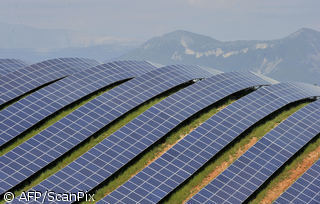 For the past few years, researchers have been using quantum dots to increase the light absorption and overall efficiency of solar cells.
The researchers, Kimberly Sablon and John W. Little (US Army Research Laboratory in Adelphi, Maryland), Vladimir Mitin, Andrei Sergeev, and Nizami Vagidov (University of Buffalo in Buffalo, New York), and Kitt Reinhardt (AFOSR/NE in Arlington, Virginia) have published their study on the increased solar cell efficiency in a recent issue of Nano Letters.
In their study, the researchers studied heterostructure solar cells with InAs/GaAs quantum dots. As photovoltaic materials, the quantum dots allow for harvesting of the infrared radiation to convert it into electric energy. However, the quantum dots also enhance the recombination of photocarriers and decrease the photocurrent. For this reason, up to now the improvement of photovoltaic efficiency due to quantum dots has been limited by several percent.
Here, the researchers have proposed to charge quantum dots by using selective interdot doping. In their experiments, the researchers compared doping levels of 2, 3, and 6 additional electrons per quantum dot, which resulted in photovoltaic efficiency increases of 4.5%, 30%, and 50%, respectively, compared to an undoped solar cell. For the 6-electron doping level, that 50% increase corresponds to an overall efficiency increase from 9.3% (for undoped solar cells) to 14%.
The researchers attributed this radical improvement of the photovoltaic efficiency to two basic effects. First, the built-in-dot charge induces various transitions of the electrons and enhances harvesting of the infrared radiation. Second, the built-in-dot charge creates potential barriers around dots and these barriers suppress capture processes for electrons and do not allow them to return back into the dots.
In addition, the researchers predict that further increasing the doping level will lead to an even stronger efficiency enhancement, since there was no evidence of saturation. In the future, the researchers plan to further investigate how these effects influence each other at higher doping levels. They predict that further increasing the doping level and radiation intensity will lead to an even stronger efficiency enhancement, since there was no evidence of saturation.