About 6,000 Russian teenagers and schoolchildren staged a noisy protest outside Latvia's parliament
Published:
7 February 2004 y., Saturday
About 6,000 Russian teenagers and schoolchildren staged a noisy protest outside Latvia's parliament just before lawmakers passed a law Thursday requiring that all public schools -- including those with all-Russian student bodies -- teach mainly in Latvian.
In what was one of the largest demonstrations in recent Latvian history, hundreds of children waved mostly Russian-language placards, one reading, "Don't twist our arms. Let us speak Latvian voluntarily!"
The crowd also chanted "hands off our school" and "no to the reforms" in Russian. The new law mandates that at least 60 percent of classes in public schools, even those catering to the large Russian-speaking minority, must be taught in Latvian starting in September.
After several hours of heated debate, with many ethnic-Russian deputies speaking in opposition, the 100-seat Saeima overwhelmingly approved the legislation by a 71-25 vote. Other deputies either weren't present or didn't vote.
Russians call the requirements discriminatory and say they are an attack on their way of life, charges echoed by Moscow.
Latvians counter that they are meant to help integrate minorities, adding that those who don't learn Latvian will find it hard to secure good jobs.
Šaltinis:
themoscowtimes.com
Copying, publishing, announcing any information from the News.lt portal without written permission of News.lt editorial office is prohibited.
The most popular articles

The European Commission announced today the award of three of the six contracts for the procurement of Galileo’s initial operational capability.
more »
 In a world first, doctors in Austria have amputated the arms of two young men and replaced them with bionic prosthetics. The decision to amputate was made after the men had irreversibly lost all movement in their hands.
more »
In a world first, doctors in Austria have amputated the arms of two young men and replaced them with bionic prosthetics. The decision to amputate was made after the men had irreversibly lost all movement in their hands.
more »
 An ultra-realistic robot, known as a geminoid, is helping psychologists test how we relate to machines...
more »
An ultra-realistic robot, known as a geminoid, is helping psychologists test how we relate to machines...
more »
 Scientists from the University of Sheffield have developed pigment-free, intensely coloured polymer materials, which could provide new, anti-counterfeit devices on passports or banknotes due to their difficulty to copy.
more »
Scientists from the University of Sheffield have developed pigment-free, intensely coloured polymer materials, which could provide new, anti-counterfeit devices on passports or banknotes due to their difficulty to copy.
more »
 iRobot Corp announced plans to create Android applications for the iRobot Ava mobile robotics platform.
more »
iRobot Corp announced plans to create Android applications for the iRobot Ava mobile robotics platform.
more »
 When robots talk to each other, they're not generally using language as we think of it, with words to communicate both concrete and abstract concepts.
more »
When robots talk to each other, they're not generally using language as we think of it, with words to communicate both concrete and abstract concepts.
more »
 Using laser and nanotechnology, scientists in Chicago have been able go back in time and uncover how masterpieces from artists like Homer and Van Gogh might have looked like when they were first painted.
more »
Using laser and nanotechnology, scientists in Chicago have been able go back in time and uncover how masterpieces from artists like Homer and Van Gogh might have looked like when they were first painted.
more »
 Most mechanical resonators damp (slow down) in a well-understood linear manner, but ground-breaking work by Prof. A. Bachtold and his research group at the Catalan Institute of Nanotechnology has shown that resonators formed from nanoscale graphene and carbon nanotubes exhibit nonlinear damping, opening up exciting possibilities for super-sensitive detectors of force or mass.
more »
Most mechanical resonators damp (slow down) in a well-understood linear manner, but ground-breaking work by Prof. A. Bachtold and his research group at the Catalan Institute of Nanotechnology has shown that resonators formed from nanoscale graphene and carbon nanotubes exhibit nonlinear damping, opening up exciting possibilities for super-sensitive detectors of force or mass.
more »
 Automated driving systems, such as adaptive cruise control, may be the latest "must have" gizmos but the auto industry is already looking to their successor - cooperative driving - where cars communicate with each other as they go.
more »
Automated driving systems, such as adaptive cruise control, may be the latest "must have" gizmos but the auto industry is already looking to their successor - cooperative driving - where cars communicate with each other as they go.
more »
 For the past few years, researchers have been using quantum dots to increase the light absorption and overall efficiency of solar cells.
more »
For the past few years, researchers have been using quantum dots to increase the light absorption and overall efficiency of solar cells.
more »
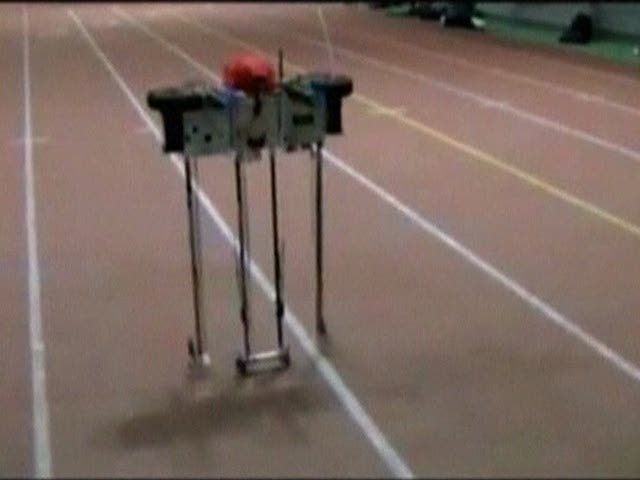 'Ranger' the robot has set a world record for its developers at Cornell University, by walking 40.5 miles non-stop on one charge.
more »
'Ranger' the robot has set a world record for its developers at Cornell University, by walking 40.5 miles non-stop on one charge.
more »