A new Uzbek media watchdog has urged international organisations promoting journalist's rights to pay more attention to the situation in this Central Asian republic where there is no independent press
Published:
19 January 2005 y., Wednesday
A new Uzbek media watchdog has urged international organisations promoting journalist's rights to pay more attention to the situation in this Central Asian republic where there is no independent press and freedom of speech is severely curtailed.
"Uzbekistan is becoming a dangerous place for journalists who dare to challenge the government," Yusuf Rasulov, head of the Association for the Protection of Journalist's Rights and Freedoms (APJRF), told IRIN in the capital, Tashkent.
Rasulov, a former Voice of America (VOA) correspondent, said the aim of the NGO was to protect the handful of independent journalists working in Uzbekistan who are often victims of harassment, attack and threats from security forces.
He was attacked and brutally beaten by a group of women, while police looked on, while covering a protest in Tashkent's huge Chorsu market in 2003. "Since then, as we have been trying to create this new NGO, I have been threatened and often watched by security people," he said.
Uzbekistan, Central Asia's most populous state, is known for imprisoning opponents of President Islam Karimov's regime or forcing them into exile and widely criticised for slow economic reforms and growing poverty, particularly in rural areas.
Western radio stations broadcasting to Uzbekistan and the region in the Uzbek language are virtually the only critical media in this Central Asian country due to strict state control of national and local broadcast and print media.
Šaltinis:
irinnews.org
Copying, publishing, announcing any information from the News.lt portal without written permission of News.lt editorial office is prohibited.
The most popular articles
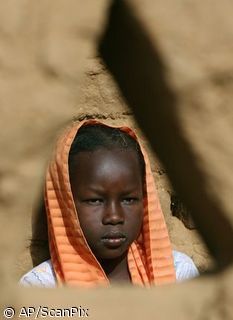 A baby girl loses her mother at birth. A few years later, she is “sold” into domestic labor by her own father.
more »
A baby girl loses her mother at birth. A few years later, she is “sold” into domestic labor by her own father.
more »
 Scarce and unevenly distributed rainfall has made water a key economic and social development issue in Morocco.
more »
Scarce and unevenly distributed rainfall has made water a key economic and social development issue in Morocco.
more »
 Rainfall in August and September 2009 confirmed the fears of serious risk of natural disasters in years to come resulting from rising sea levels, greater erosion of coastal zones, destruction of the mangroves, and devastating floods.
more »
Rainfall in August and September 2009 confirmed the fears of serious risk of natural disasters in years to come resulting from rising sea levels, greater erosion of coastal zones, destruction of the mangroves, and devastating floods.
more »
 Fifteen years after the groundbreaking Fourth World Conference on Women, which was held in Beijing in 1995, the international community has clear legal norms on the prohibition of discrimination and the active promotion of gender equality and women's empowerment.
more »
Fifteen years after the groundbreaking Fourth World Conference on Women, which was held in Beijing in 1995, the international community has clear legal norms on the prohibition of discrimination and the active promotion of gender equality and women's empowerment.
more »
 Ahead of International Women's Day, the European Commission strengthened and deepened its commitment to equality between women and men with a Women's Charter.
more »
Ahead of International Women's Day, the European Commission strengthened and deepened its commitment to equality between women and men with a Women's Charter.
more »
 The World Bank Institute has launched an online multiplayer game, EVOKE, designed to empower young people all over the world, but especially in Africa, to start solving urgent social problems like hunger, poverty, disease, conflict, climate change, sustainable energy, lack of health care and education.
more »
The World Bank Institute has launched an online multiplayer game, EVOKE, designed to empower young people all over the world, but especially in Africa, to start solving urgent social problems like hunger, poverty, disease, conflict, climate change, sustainable energy, lack of health care and education.
more »
 One of the crucial questions facing EU asylum policy is the extent to which countries share the demands of asylum seekers.
more »
One of the crucial questions facing EU asylum policy is the extent to which countries share the demands of asylum seekers.
more »
 Youth in three major universities explored what they can do to address climate change, something that experts in a knowledge-sharing forum in Silliman University in Dumaguete City say is already at Filipinos’ doorsteps.
more »
Youth in three major universities explored what they can do to address climate change, something that experts in a knowledge-sharing forum in Silliman University in Dumaguete City say is already at Filipinos’ doorsteps.
more »
 The Parliament needs to connect more with women voters as research shows them to be trapped in a vicious circle, being under-represented in the EP and EU politics in general and, therefore, less interested and less involved than men.
more »
The Parliament needs to connect more with women voters as research shows them to be trapped in a vicious circle, being under-represented in the EP and EU politics in general and, therefore, less interested and less involved than men.
more »
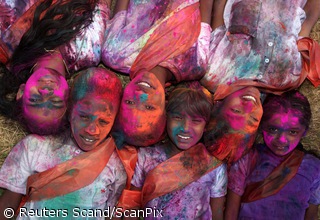 The streets of India became a kaleidoscope of colour, as locals celebrated Holi.
more »
The streets of India became a kaleidoscope of colour, as locals celebrated Holi.
more »