White House Urged To Use Internet As Human-Rights Soapbox
Published:
11 February 2001 y., Sunday
The Bush administration should consider reaching out to other nations to encourage use of the Internet as a tool for promoting US interests and improving human rights conditions abroad, a report issued publicly today asserts.
"To advance American security, political and economic interests, the United States should focus greater attention upon fostering the expansion of foreign Internet access and use, particularly in nations that are economically marginalized or struggling to solidify democracy," the Lawyers Committee for Human Rights said.
The report, presented to top-ranking officials in the Bush administration on Thursday, advocates a policy of techno-activism abroad to fight foreign oppressive regimes and to pave the way for American high-tech companies.
"Because the US private sector remains a leader in all aspects of information technology, American firms are well positioned to provide the infrastructure, hardware, software and training needed as Internet use expands," the report notes.
The 200-page study likens the Internet – as a tool for democratization – to the influence of Radio Free Europe and Voice of America during the Cold War, noting that the Web has enormous potential in exporting American values and democratization in many repressive nations that restrict media and the press.
The study also references a recent estimate by the international press advocacy group Reporters Sans Frontieres (Reporters Without Borders), which says more than 45 countries "severely restrict" the Internet by forcing users to filter content, subscribe to a state-run ISP or register with authorities.
The group said some 20 nations, including Iran, Iraq, Libya, China, Cuba and North Korea and several other countries that the US keeps at a safe distance virtually ban the Internet from their borders. Such nations are just as likely to use the Internet against their own citizens, the Lawyers Committee said.
The report urges the Bush administration to call for end to all government restrictions on Web use, and to use its embassies and military bases abroad as a jumping off point for expanding public Internet access for non-commercial users.
Šaltinis:
Newsbytes
Copying, publishing, announcing any information from the News.lt portal without written permission of News.lt editorial office is prohibited.
The most popular articles
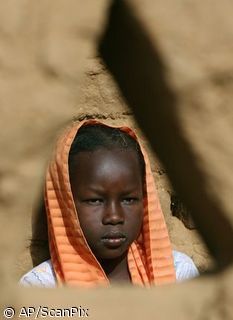 A baby girl loses her mother at birth. A few years later, she is “sold” into domestic labor by her own father.
more »
A baby girl loses her mother at birth. A few years later, she is “sold” into domestic labor by her own father.
more »
 Scarce and unevenly distributed rainfall has made water a key economic and social development issue in Morocco.
more »
Scarce and unevenly distributed rainfall has made water a key economic and social development issue in Morocco.
more »
 Rainfall in August and September 2009 confirmed the fears of serious risk of natural disasters in years to come resulting from rising sea levels, greater erosion of coastal zones, destruction of the mangroves, and devastating floods.
more »
Rainfall in August and September 2009 confirmed the fears of serious risk of natural disasters in years to come resulting from rising sea levels, greater erosion of coastal zones, destruction of the mangroves, and devastating floods.
more »
 Fifteen years after the groundbreaking Fourth World Conference on Women, which was held in Beijing in 1995, the international community has clear legal norms on the prohibition of discrimination and the active promotion of gender equality and women's empowerment.
more »
Fifteen years after the groundbreaking Fourth World Conference on Women, which was held in Beijing in 1995, the international community has clear legal norms on the prohibition of discrimination and the active promotion of gender equality and women's empowerment.
more »
 Ahead of International Women's Day, the European Commission strengthened and deepened its commitment to equality between women and men with a Women's Charter.
more »
Ahead of International Women's Day, the European Commission strengthened and deepened its commitment to equality between women and men with a Women's Charter.
more »
 The World Bank Institute has launched an online multiplayer game, EVOKE, designed to empower young people all over the world, but especially in Africa, to start solving urgent social problems like hunger, poverty, disease, conflict, climate change, sustainable energy, lack of health care and education.
more »
The World Bank Institute has launched an online multiplayer game, EVOKE, designed to empower young people all over the world, but especially in Africa, to start solving urgent social problems like hunger, poverty, disease, conflict, climate change, sustainable energy, lack of health care and education.
more »
 One of the crucial questions facing EU asylum policy is the extent to which countries share the demands of asylum seekers.
more »
One of the crucial questions facing EU asylum policy is the extent to which countries share the demands of asylum seekers.
more »
 Youth in three major universities explored what they can do to address climate change, something that experts in a knowledge-sharing forum in Silliman University in Dumaguete City say is already at Filipinos’ doorsteps.
more »
Youth in three major universities explored what they can do to address climate change, something that experts in a knowledge-sharing forum in Silliman University in Dumaguete City say is already at Filipinos’ doorsteps.
more »
 The Parliament needs to connect more with women voters as research shows them to be trapped in a vicious circle, being under-represented in the EP and EU politics in general and, therefore, less interested and less involved than men.
more »
The Parliament needs to connect more with women voters as research shows them to be trapped in a vicious circle, being under-represented in the EP and EU politics in general and, therefore, less interested and less involved than men.
more »
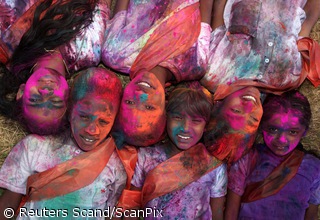 The streets of India became a kaleidoscope of colour, as locals celebrated Holi.
more »
The streets of India became a kaleidoscope of colour, as locals celebrated Holi.
more »