White House Urged To Use Internet As Human-Rights Soapbox
Published:
11 February 2001 y., Sunday
The Bush administration should consider reaching out to other nations to encourage use of the Internet as a tool for promoting US interests and improving human rights conditions abroad, a report issued publicly today asserts.
"To advance American security, political and economic interests, the United States should focus greater attention upon fostering the expansion of foreign Internet access and use, particularly in nations that are economically marginalized or struggling to solidify democracy," the Lawyers Committee for Human Rights said.
The report, presented to top-ranking officials in the Bush administration on Thursday, advocates a policy of techno-activism abroad to fight foreign oppressive regimes and to pave the way for American high-tech companies.
"Because the US private sector remains a leader in all aspects of information technology, American firms are well positioned to provide the infrastructure, hardware, software and training needed as Internet use expands," the report notes.
The 200-page study likens the Internet – as a tool for democratization – to the influence of Radio Free Europe and Voice of America during the Cold War, noting that the Web has enormous potential in exporting American values and democratization in many repressive nations that restrict media and the press.
The study also references a recent estimate by the international press advocacy group Reporters Sans Frontieres (Reporters Without Borders), which says more than 45 countries "severely restrict" the Internet by forcing users to filter content, subscribe to a state-run ISP or register with authorities.
The group said some 20 nations, including Iran, Iraq, Libya, China, Cuba and North Korea and several other countries that the US keeps at a safe distance virtually ban the Internet from their borders. Such nations are just as likely to use the Internet against their own citizens, the Lawyers Committee said.
The report urges the Bush administration to call for end to all government restrictions on Web use, and to use its embassies and military bases abroad as a jumping off point for expanding public Internet access for non-commercial users.
Šaltinis:
Newsbytes
Copying, publishing, announcing any information from the News.lt portal without written permission of News.lt editorial office is prohibited.
The most popular articles
 You can now access books, journals, films, maps etc from across Europe via the EU's online library, Europeana.
more »
You can now access books, journals, films, maps etc from across Europe via the EU's online library, Europeana.
more »
 Late night chat turned serious when comedian David Letterman admitted he had sex with female employees and was being blackmailed for $2-million (USD) over the affairs.
more »
Late night chat turned serious when comedian David Letterman admitted he had sex with female employees and was being blackmailed for $2-million (USD) over the affairs.
more »
 Last Thursday (1 October) saw an agreement that will lead to the introduction of more efficient tyres for cars and lorries that will cut fuel bills and CO2 emissions.
more »
Last Thursday (1 October) saw an agreement that will lead to the introduction of more efficient tyres for cars and lorries that will cut fuel bills and CO2 emissions.
more »
 The European Job Days are taking place around the EU over the next fortnight, with a centrepiece event in Brussels on 3 October.
more »
The European Job Days are taking place around the EU over the next fortnight, with a centrepiece event in Brussels on 3 October.
more »
 Women, especially migrant and/or poor women, have been harder hit by the financial crisis than men, MEPs heard on Wednesday.
more »
Women, especially migrant and/or poor women, have been harder hit by the financial crisis than men, MEPs heard on Wednesday.
more »
 New EU plan to make local transport efficient and sustainable.
more »
New EU plan to make local transport efficient and sustainable.
more »
 Hollywood heavyweights and European cultural figures are rallying behind jailed film director Roman Polanski.
more »
Hollywood heavyweights and European cultural figures are rallying behind jailed film director Roman Polanski.
more »
 By the time of his death in the Moscow winter 20 years ago, Andrei Sakharov had built an international reputation as a nuclear physicist, human rights activist and Nobel Peace Prize winner His fears over the implications of his work led him to call for peaceful coexistence and later for human rights in the USSR.
more »
By the time of his death in the Moscow winter 20 years ago, Andrei Sakharov had built an international reputation as a nuclear physicist, human rights activist and Nobel Peace Prize winner His fears over the implications of his work led him to call for peaceful coexistence and later for human rights in the USSR.
more »
 The ten nominations for this year's Sakharov Prize, the EP's prize for defenders of human rights and democracy, have now been put forward and will be officially presented at the end of the month.
more »
The ten nominations for this year's Sakharov Prize, the EP's prize for defenders of human rights and democracy, have now been put forward and will be officially presented at the end of the month.
more »
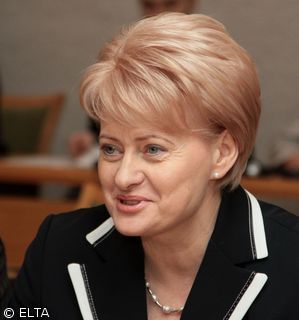 President of the Republic of Lithuania Dalia Grybauskaitė attended a meeting hosted by the President of Liberia Ellen Johnson-Sirleaf and the President of Finland Tarja Halonen on Peace and Security through Women's Leadership.
more »
President of the Republic of Lithuania Dalia Grybauskaitė attended a meeting hosted by the President of Liberia Ellen Johnson-Sirleaf and the President of Finland Tarja Halonen on Peace and Security through Women's Leadership.
more »