An acronym that had dominated headlines at previous CeBIT shows seemed to be little more than a footnote at this year's event
Published:
18 March 2003 y., Tuesday
An acronym that had dominated headlines at previous CeBIT shows seemed to be little more than a footnote at this year's event. The buzz that once accompanied 3G (third-generation) broadband mobile Internet appears to have fizzled even before the service has taken off.
Grabbing the attention this year were wireless technologies, such as Wi-Fi and Bluetooth, that are, above all, available.
Indeed, handset availability, which dogged the start of GSM (Global Service for Mobility Communications) in Europe over a decade ago, threatens to trip mobile operators eager to expand into the market for high-speed mobile Internet services.
Continuing a troubling trend in the European mobile industry, Jьrgen von Kuczkowski, head of Vodafone Group PLC's German unit, said last week in Hanover that the operator will delay the launch of commercial 3G service, this time to the second half of 2003 and only then if enough handsets are available. But Kuczkowski was quick to defuse speculation of possible difficulties, should the operator be forced to announce yet another delay. "There will be no Big Bang" when the German subsidiary launches 3G, he said. "It's not at all important if you start a few weeks earlier or later."
For the record, the delay has been nearly a year. Vodafone D2 GmbH has been paying interest on a huge loan for its Ђ8.5 billion (US$9.2 billion) 3G license acquired more than two years ago, while generating zero revenue from the new mobile broadband service during this time.
Now Kuczkowski is talking about testing 3G with a select number of business users over the next few months. He has also dropped some price points: 3G handsets will cost around Ђ300 and fees for the new high-speed packet-based data services will be low enough to compete with the competition. Those remarks were aimed at rival T-Mobile Deutschland AG, which announced plans ahead of CeBIT to cut its mobile data fees for GPRS (General Packet Radio Service) up to 70 percent, with handsets to range from Ђ100 to Ђ500.
T-Mobile and Vodafone account for roughly 70 percent of the German mobile market, the largest in Europe.
Šaltinis:
itworld.com
Copying, publishing, announcing any information from the News.lt portal without written permission of News.lt editorial office is prohibited.
The most popular articles
 You can now access books, journals, films, maps etc from across Europe via the EU's online library, Europeana.
more »
You can now access books, journals, films, maps etc from across Europe via the EU's online library, Europeana.
more »
 Late night chat turned serious when comedian David Letterman admitted he had sex with female employees and was being blackmailed for $2-million (USD) over the affairs.
more »
Late night chat turned serious when comedian David Letterman admitted he had sex with female employees and was being blackmailed for $2-million (USD) over the affairs.
more »
 Last Thursday (1 October) saw an agreement that will lead to the introduction of more efficient tyres for cars and lorries that will cut fuel bills and CO2 emissions.
more »
Last Thursday (1 October) saw an agreement that will lead to the introduction of more efficient tyres for cars and lorries that will cut fuel bills and CO2 emissions.
more »
 The European Job Days are taking place around the EU over the next fortnight, with a centrepiece event in Brussels on 3 October.
more »
The European Job Days are taking place around the EU over the next fortnight, with a centrepiece event in Brussels on 3 October.
more »
 Women, especially migrant and/or poor women, have been harder hit by the financial crisis than men, MEPs heard on Wednesday.
more »
Women, especially migrant and/or poor women, have been harder hit by the financial crisis than men, MEPs heard on Wednesday.
more »
 New EU plan to make local transport efficient and sustainable.
more »
New EU plan to make local transport efficient and sustainable.
more »
 Hollywood heavyweights and European cultural figures are rallying behind jailed film director Roman Polanski.
more »
Hollywood heavyweights and European cultural figures are rallying behind jailed film director Roman Polanski.
more »
 By the time of his death in the Moscow winter 20 years ago, Andrei Sakharov had built an international reputation as a nuclear physicist, human rights activist and Nobel Peace Prize winner His fears over the implications of his work led him to call for peaceful coexistence and later for human rights in the USSR.
more »
By the time of his death in the Moscow winter 20 years ago, Andrei Sakharov had built an international reputation as a nuclear physicist, human rights activist and Nobel Peace Prize winner His fears over the implications of his work led him to call for peaceful coexistence and later for human rights in the USSR.
more »
 The ten nominations for this year's Sakharov Prize, the EP's prize for defenders of human rights and democracy, have now been put forward and will be officially presented at the end of the month.
more »
The ten nominations for this year's Sakharov Prize, the EP's prize for defenders of human rights and democracy, have now been put forward and will be officially presented at the end of the month.
more »
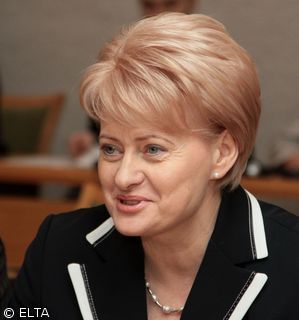 President of the Republic of Lithuania Dalia Grybauskaitė attended a meeting hosted by the President of Liberia Ellen Johnson-Sirleaf and the President of Finland Tarja Halonen on Peace and Security through Women's Leadership.
more »
President of the Republic of Lithuania Dalia Grybauskaitė attended a meeting hosted by the President of Liberia Ellen Johnson-Sirleaf and the President of Finland Tarja Halonen on Peace and Security through Women's Leadership.
more »