A group of Russian and international environmental organizations have sent a letter to the World Bank’s president James Wolfensohn.
Published:
15 July 2000 y., Saturday
A group of Russian and international environmental organizations have sent a letter to the World Bank’s president James Wolfensohn urging the head of the world’s most powerful international financial institution to halt all loans and cease financing environmental projects in Russia. The first installment of a $60 million loan to the Russian Federal Forest Service was made five days after the agency was dissolved. On May 17, 2000, President Putin issued a decree dissolving the State Committee for Environmental Protection and the Federal Forest Service. The activities of both agencies are now under the jurisdiction of the Ministry of Natural Resources.
The committee was responsible for monitoring all aspects of the environment except for nuclear safety. Environmentalists insist no loans should be granted until President Putin re-establishes the Committee for Environmental Protection and the Forest Service. The authors of the letter fear that not a single ruble of that loan will be used for forest fire protection as stipulated in the loan agreement and that the Ministry for Natural Resources will only embezzle those funds. The World Bank has so far granted in excess of $1 billion worth of loans for environmental protection projects in Russia. The latest loan of $60 million is earmarked for “implementation of the forest pilot project”, aimed at preventing and fighting forest fires.
It was the renowned environmentalist Alexei Yablokov, the president of the Center for Environment Policy and a co-Chairman of International Socio-Ecological Union, who proposed addressing the World Bank. The letter was signed by 57 mainly Russian organizations.
Šaltinis:
Gazeta.Ru
Copying, publishing, announcing any information from the News.lt portal without written permission of News.lt editorial office is prohibited.
The most popular articles
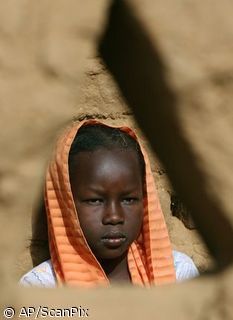 A baby girl loses her mother at birth. A few years later, she is “sold” into domestic labor by her own father.
more »
A baby girl loses her mother at birth. A few years later, she is “sold” into domestic labor by her own father.
more »
 Scarce and unevenly distributed rainfall has made water a key economic and social development issue in Morocco.
more »
Scarce and unevenly distributed rainfall has made water a key economic and social development issue in Morocco.
more »
 Rainfall in August and September 2009 confirmed the fears of serious risk of natural disasters in years to come resulting from rising sea levels, greater erosion of coastal zones, destruction of the mangroves, and devastating floods.
more »
Rainfall in August and September 2009 confirmed the fears of serious risk of natural disasters in years to come resulting from rising sea levels, greater erosion of coastal zones, destruction of the mangroves, and devastating floods.
more »
 Fifteen years after the groundbreaking Fourth World Conference on Women, which was held in Beijing in 1995, the international community has clear legal norms on the prohibition of discrimination and the active promotion of gender equality and women's empowerment.
more »
Fifteen years after the groundbreaking Fourth World Conference on Women, which was held in Beijing in 1995, the international community has clear legal norms on the prohibition of discrimination and the active promotion of gender equality and women's empowerment.
more »
 Ahead of International Women's Day, the European Commission strengthened and deepened its commitment to equality between women and men with a Women's Charter.
more »
Ahead of International Women's Day, the European Commission strengthened and deepened its commitment to equality between women and men with a Women's Charter.
more »
 The World Bank Institute has launched an online multiplayer game, EVOKE, designed to empower young people all over the world, but especially in Africa, to start solving urgent social problems like hunger, poverty, disease, conflict, climate change, sustainable energy, lack of health care and education.
more »
The World Bank Institute has launched an online multiplayer game, EVOKE, designed to empower young people all over the world, but especially in Africa, to start solving urgent social problems like hunger, poverty, disease, conflict, climate change, sustainable energy, lack of health care and education.
more »
 One of the crucial questions facing EU asylum policy is the extent to which countries share the demands of asylum seekers.
more »
One of the crucial questions facing EU asylum policy is the extent to which countries share the demands of asylum seekers.
more »
 Youth in three major universities explored what they can do to address climate change, something that experts in a knowledge-sharing forum in Silliman University in Dumaguete City say is already at Filipinos’ doorsteps.
more »
Youth in three major universities explored what they can do to address climate change, something that experts in a knowledge-sharing forum in Silliman University in Dumaguete City say is already at Filipinos’ doorsteps.
more »
 The Parliament needs to connect more with women voters as research shows them to be trapped in a vicious circle, being under-represented in the EP and EU politics in general and, therefore, less interested and less involved than men.
more »
The Parliament needs to connect more with women voters as research shows them to be trapped in a vicious circle, being under-represented in the EP and EU politics in general and, therefore, less interested and less involved than men.
more »
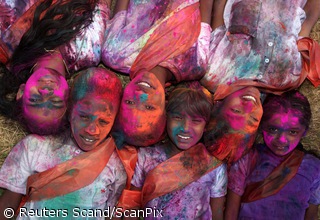 The streets of India became a kaleidoscope of colour, as locals celebrated Holi.
more »
The streets of India became a kaleidoscope of colour, as locals celebrated Holi.
more »