Fewer workers to support greater number of retirees
Published:
30 March 2003 y., Sunday
When Secretary of Defense Donald H. Rumsfeld recently disparaged France and Germany as "Old Europe," maybe he was speaking demographically.
According to a new study of the European Union's 15 member nations, governments there are facing an age problem that is almost certain to get worse. European families are having fewer children, and are exacerbating the problem by delaying child-bearing.
As a result, the research team said, Europeans face higher health and welfare costs, fewer wage-earners, and an impact on national productivity. In other words, a downward spiral has begun, and soon fewer young workers will be supporting more and more old retirees.
Although their calculations predict a slight population rise over the next 15 years - the result of a "baby boom" in the 1960s - the researchers see Europe having 88 million fewer people when the year 2100 rolls around, down from about 230 million.
One of the researchers, Brian O'Neill at Brown University in Providence, R.I., said the data show "there are fewer children today than there are parents" in the European Union. "So we know the number of parents one generation in the future is going to be even smaller.
"Then there is the additional factor of delay," which accounts for about 40 percent of the expected decline, he said.
Europe has about four working-age persons for every elderly person, the researchers said. But they predict that there "will be considerably less than three" workers per retiree for most of this century, even if young families begin having children sooner.
Šaltinis:
The Sun
Copying, publishing, announcing any information from the News.lt portal without written permission of News.lt editorial office is prohibited.
The most popular articles
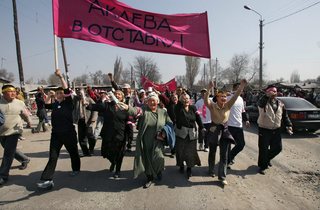 Civil unrest in Kyrgyzstan last week left over 70 people dead, more than 1500 injured and over 500 hospitalized.
more »
Civil unrest in Kyrgyzstan last week left over 70 people dead, more than 1500 injured and over 500 hospitalized.
more »
 After lots were drawn, ten winners of Danske Bankas scholarships and one winner of an iPod shuffle player were established.
more »
After lots were drawn, ten winners of Danske Bankas scholarships and one winner of an iPod shuffle player were established.
more »
 The health of Chinese civil rights activist Hu Jia is causing real fears after reports that the winner of the Parliament's 2008 Sakharov human rights prize is ailing with liver disease.
more »
The health of Chinese civil rights activist Hu Jia is causing real fears after reports that the winner of the Parliament's 2008 Sakharov human rights prize is ailing with liver disease.
more »
 Nestled in the northeast plains of India, Bihar is one of the poorest states in the country. Its per capita income is just a fraction of that in other Indian states.
more »
Nestled in the northeast plains of India, Bihar is one of the poorest states in the country. Its per capita income is just a fraction of that in other Indian states.
more »
 One day after a 7.2 magnitude earthquake rattled the Mexico-California border area, Mexico‘s President visits one of the affected areas.
more »
One day after a 7.2 magnitude earthquake rattled the Mexico-California border area, Mexico‘s President visits one of the affected areas.
more »
 Roma communities, the European Union’s largest ethnic minority, continue to face persistent discrimination and segregation.
more »
Roma communities, the European Union’s largest ethnic minority, continue to face persistent discrimination and segregation.
more »
 This the sound of spring for many in Latvia. With a little guidance from their parents, children at the Riga Zoo made bird boxes in anticipation of the returning migrating birds.
more »
This the sound of spring for many in Latvia. With a little guidance from their parents, children at the Riga Zoo made bird boxes in anticipation of the returning migrating birds.
more »
 Economic shocks are taking a toll on a population already facing high risks in low-income countries: children.
more »
Economic shocks are taking a toll on a population already facing high risks in low-income countries: children.
more »
 As celebrations for Easter week get under way millions of the faithful will be heading to Churches across Europe to mark the crucifixion and resurrection of Christ.
more »
As celebrations for Easter week get under way millions of the faithful will be heading to Churches across Europe to mark the crucifixion and resurrection of Christ.
more »
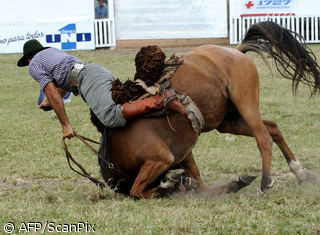 More than 200, 000 riders and their horses are in Uruguay’s capital for South America’s largest rodeo.
more »
More than 200, 000 riders and their horses are in Uruguay’s capital for South America’s largest rodeo.
more »