Fewer workers to support greater number of retirees
Published:
30 March 2003 y., Sunday
When Secretary of Defense Donald H. Rumsfeld recently disparaged France and Germany as "Old Europe," maybe he was speaking demographically.
According to a new study of the European Union's 15 member nations, governments there are facing an age problem that is almost certain to get worse. European families are having fewer children, and are exacerbating the problem by delaying child-bearing.
As a result, the research team said, Europeans face higher health and welfare costs, fewer wage-earners, and an impact on national productivity. In other words, a downward spiral has begun, and soon fewer young workers will be supporting more and more old retirees.
Although their calculations predict a slight population rise over the next 15 years - the result of a "baby boom" in the 1960s - the researchers see Europe having 88 million fewer people when the year 2100 rolls around, down from about 230 million.
One of the researchers, Brian O'Neill at Brown University in Providence, R.I., said the data show "there are fewer children today than there are parents" in the European Union. "So we know the number of parents one generation in the future is going to be even smaller.
"Then there is the additional factor of delay," which accounts for about 40 percent of the expected decline, he said.
Europe has about four working-age persons for every elderly person, the researchers said. But they predict that there "will be considerably less than three" workers per retiree for most of this century, even if young families begin having children sooner.
Šaltinis:
The Sun
Copying, publishing, announcing any information from the News.lt portal without written permission of News.lt editorial office is prohibited.
The most popular articles
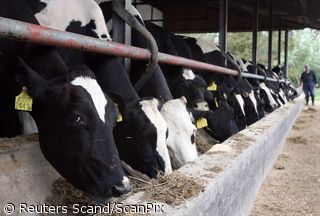 In the final session of the February plenary MEPs gathered to discuss the issue of correct labelling for animal feeds. BSE, CJD and 'mad cow' disease stemmed directly from using contaminated animal feeds leading to widespread culls and fear of the unknown.
more »
In the final session of the February plenary MEPs gathered to discuss the issue of correct labelling for animal feeds. BSE, CJD and 'mad cow' disease stemmed directly from using contaminated animal feeds leading to widespread culls and fear of the unknown.
more »
 Officials of Australia are warning residents of country's second largest state to keep an eye out for crocs and other animals roaming the area.
more »
Officials of Australia are warning residents of country's second largest state to keep an eye out for crocs and other animals roaming the area.
more »
 MEPs believe “the right to speak and to be educated in one's mother tongue is one of the most basic fundamental rights” and on Tuesday Hungarian Socialist Csaba Tabajdi and five other MEPs grilled the Commission on its plans to protect traditional national, ethnic and immigrant minorities in Europe.
more »
MEPs believe “the right to speak and to be educated in one's mother tongue is one of the most basic fundamental rights” and on Tuesday Hungarian Socialist Csaba Tabajdi and five other MEPs grilled the Commission on its plans to protect traditional national, ethnic and immigrant minorities in Europe.
more »
 Thirteen thousand people from as far as Japan gathered in western Pennsylvania to see if spring will come early.
more »
Thirteen thousand people from as far as Japan gathered in western Pennsylvania to see if spring will come early.
more »
 The self-described "mom-in-chief," First Lady Michelle Obama, took to the podium at the U.S. Department of Education.
more »
The self-described "mom-in-chief," First Lady Michelle Obama, took to the podium at the U.S. Department of Education.
more »
 Most Europeans are unhappy with the bus and train services in their cities, and a large percentage complain about their power companies and banks, an EU survey shows.
more »
Most Europeans are unhappy with the bus and train services in their cities, and a large percentage complain about their power companies and banks, an EU survey shows.
more »
 Thousands turned out in Moscow for the enthronement of the Russian Orthodox Church's - the world's second-biggest Church - new leader.
more »
Thousands turned out in Moscow for the enthronement of the Russian Orthodox Church's - the world's second-biggest Church - new leader.
more »
 India‘s slum dwellers are taken to the streets in protest at the name of the Oscar-nominated film "Slumdog Millionaire."
more »
India‘s slum dwellers are taken to the streets in protest at the name of the Oscar-nominated film "Slumdog Millionaire."
more »
 Chris Ogle bought a second hand MP3 player in America for just 10 dollars and back home in New Zealand he found it contained 60 confidential US military files.
more »
Chris Ogle bought a second hand MP3 player in America for just 10 dollars and back home in New Zealand he found it contained 60 confidential US military files.
more »
 European Commissioner for Development and Humanitarian Aid, Louis Michel, announced the planned funding as he visited the Middle East region on a two-day humanitarian mission.
more »
European Commissioner for Development and Humanitarian Aid, Louis Michel, announced the planned funding as he visited the Middle East region on a two-day humanitarian mission.
more »