The newly formed Russian Baltic Party of Estonia plans to create Estonia's first Baltic Russian history museum next fall as part of its platform to improve life for Estonia's Russian minorities, said party board member Viktor Lanberg.
Published:
21 July 2000 y., Friday
RBPE formed last June as a splinter of the Russian-speaking People's Trust party. One of its major cultural projects includes a museum intended to preserve Russian culture in the Baltics and improve attitudes toward ethnic Russians living in Estonia, Lanberg said.
Lanberg said he hopes the museum, which will be housed in Tallinn, will help raise awareness that Russians were contributing members of the Baltics long before the great influx of Soviet Russians led to tensions between the two cultures.
"It is politically not fair, and historically not right to think that the history of Russians in the Baltics started in the 1940s," said Lanberg, adding that Russian immigrant groups were important contributors to Estonian culture as far back as the 13th century - long before Soviet Russification policies
increased the Russian population of Estonia to nearly 40 percent.
Lanberg said the party, which now has 800 members, will try to find funding for the museum from next year's budget. If Parliament approves the funding, the museum will house historical documents, photos and artifacts from as far back as the 13th century.
Much of the museum's content will be contributed by archivist Alexander Dormidontov, whose photo collection of Baltic-Russian culture has traveled throughout Estonia and was on display at Parliament last spring.
Dormidontov, who will be a permanent board member of the museum, said he wanted to find a better way to preserve what he and others have collected as well as give ethnic Estonians and Russians another perspective on the country's history.
Šaltinis:
The Baltic Times
Copying, publishing, announcing any information from the News.lt portal without written permission of News.lt editorial office is prohibited.
The most popular articles
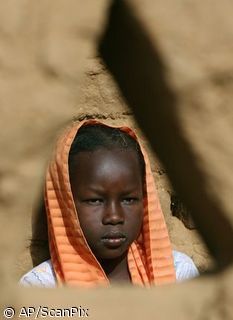 A baby girl loses her mother at birth. A few years later, she is “sold” into domestic labor by her own father.
more »
A baby girl loses her mother at birth. A few years later, she is “sold” into domestic labor by her own father.
more »
 Scarce and unevenly distributed rainfall has made water a key economic and social development issue in Morocco.
more »
Scarce and unevenly distributed rainfall has made water a key economic and social development issue in Morocco.
more »
 Rainfall in August and September 2009 confirmed the fears of serious risk of natural disasters in years to come resulting from rising sea levels, greater erosion of coastal zones, destruction of the mangroves, and devastating floods.
more »
Rainfall in August and September 2009 confirmed the fears of serious risk of natural disasters in years to come resulting from rising sea levels, greater erosion of coastal zones, destruction of the mangroves, and devastating floods.
more »
 Fifteen years after the groundbreaking Fourth World Conference on Women, which was held in Beijing in 1995, the international community has clear legal norms on the prohibition of discrimination and the active promotion of gender equality and women's empowerment.
more »
Fifteen years after the groundbreaking Fourth World Conference on Women, which was held in Beijing in 1995, the international community has clear legal norms on the prohibition of discrimination and the active promotion of gender equality and women's empowerment.
more »
 Ahead of International Women's Day, the European Commission strengthened and deepened its commitment to equality between women and men with a Women's Charter.
more »
Ahead of International Women's Day, the European Commission strengthened and deepened its commitment to equality between women and men with a Women's Charter.
more »
 The World Bank Institute has launched an online multiplayer game, EVOKE, designed to empower young people all over the world, but especially in Africa, to start solving urgent social problems like hunger, poverty, disease, conflict, climate change, sustainable energy, lack of health care and education.
more »
The World Bank Institute has launched an online multiplayer game, EVOKE, designed to empower young people all over the world, but especially in Africa, to start solving urgent social problems like hunger, poverty, disease, conflict, climate change, sustainable energy, lack of health care and education.
more »
 One of the crucial questions facing EU asylum policy is the extent to which countries share the demands of asylum seekers.
more »
One of the crucial questions facing EU asylum policy is the extent to which countries share the demands of asylum seekers.
more »
 Youth in three major universities explored what they can do to address climate change, something that experts in a knowledge-sharing forum in Silliman University in Dumaguete City say is already at Filipinos’ doorsteps.
more »
Youth in three major universities explored what they can do to address climate change, something that experts in a knowledge-sharing forum in Silliman University in Dumaguete City say is already at Filipinos’ doorsteps.
more »
 The Parliament needs to connect more with women voters as research shows them to be trapped in a vicious circle, being under-represented in the EP and EU politics in general and, therefore, less interested and less involved than men.
more »
The Parliament needs to connect more with women voters as research shows them to be trapped in a vicious circle, being under-represented in the EP and EU politics in general and, therefore, less interested and less involved than men.
more »
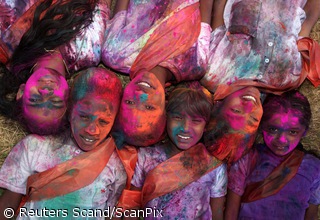 The streets of India became a kaleidoscope of colour, as locals celebrated Holi.
more »
The streets of India became a kaleidoscope of colour, as locals celebrated Holi.
more »