A discussion is under way inside the European Union as to how many years are required before its new members will match the living standards prevailing in the rest of the now 25-nation EU
Published:
12 August 2004 y., Thursday
A discussion is under way inside the European Union as to how many years are required before its new members will match the living standards prevailing in the rest of the now 25-nation EU. Many economists predict that even those new members that have relatively strong economies will require at least 30 years to reach the per-capita income levels prevailing in Western Europe.
Of the new EU members, Slovakia and three Baltic states are generally considered to be the fastest-growing economically. Each of them aspire to match the achievement of one of the oldest members of the EU, Ireland, which in the 1990s registered economic growth rates averaging over eight percent.
Willem Buiter, chief economist at the European Bank for Reconstruction and Development in London, says Ireland is a worthy model for the new EU members.
"Ireland has done it. From being a poor west European country they are now a rich west European country, richer than the average west European country and richer even than Britain," he said. "But they had a number of factors working for them that are not present in Eastern Europe, the main thing being the demographics."
Barbara Boettcher, an economist at Deutsche Bank in Frankfurt, agrees that the Ireland model won't be easy to emulate.
"You won't see that in Eastern Europe," she said. "Eastern European countries, which are designed to be winners are those that have attracted a large share of the production oriented foreign direct investment, like Slovakia, Hungary and the Czech Republic have done."
Šaltinis:
voanews.com
Copying, publishing, announcing any information from the News.lt portal without written permission of News.lt editorial office is prohibited.
The most popular articles
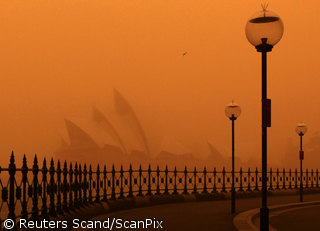 The Sydney skyline cleared Thursday, after an enormous dust storm clouded the city under a red hue a day earlier. Sydney residents began cleaning their city after a huge outback dust storm blew tones of soil into the city.
more »
The Sydney skyline cleared Thursday, after an enormous dust storm clouded the city under a red hue a day earlier. Sydney residents began cleaning their city after a huge outback dust storm blew tones of soil into the city.
more »
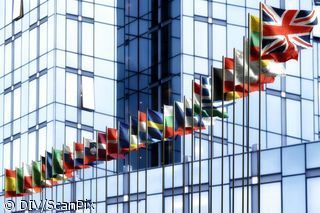 European day of languages is a celebration of the many languages spoken in the EU.
more »
European day of languages is a celebration of the many languages spoken in the EU.
more »
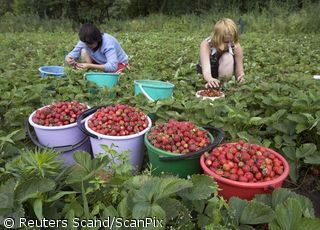 Job fairs pitch benefits of working abroad in the EU.
more »
Job fairs pitch benefits of working abroad in the EU.
more »
 The world’s poor will bear the brunt of the impact of global climate change.
more »
The world’s poor will bear the brunt of the impact of global climate change.
more »
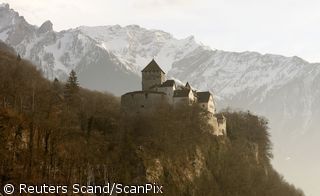 The European Heritage Days – supported by the European Commission – will once again attract around 20 million people in 49 countries to visit selected sites and monuments.
more »
The European Heritage Days – supported by the European Commission – will once again attract around 20 million people in 49 countries to visit selected sites and monuments.
more »
 An Asian black bear attacked a group of tourists waiting at this bus station in a mountainous region of central Japan.
more »
An Asian black bear attacked a group of tourists waiting at this bus station in a mountainous region of central Japan.
more »
 One hundred and sixty-eight couples line up to say “I Do.” The mass wedding ceremony took place at Singapore's Botanic Gardens to mark the attraction's 150th anniversary.
more »
One hundred and sixty-eight couples line up to say “I Do.” The mass wedding ceremony took place at Singapore's Botanic Gardens to mark the attraction's 150th anniversary.
more »
 The Commission celebrates this year's European Day of Languages, 26 September, for almost a week.
more »
The Commission celebrates this year's European Day of Languages, 26 September, for almost a week.
more »
 New navigation and layout make it easier to find what you’re looking for on the EU site’s main pages – in any official EU language.
more »
New navigation and layout make it easier to find what you’re looking for on the EU site’s main pages – in any official EU language.
more »
 The Helsinki Commission, Helcom, receives the Swedish Baltic Sea Water Award 2009.
more »
The Helsinki Commission, Helcom, receives the Swedish Baltic Sea Water Award 2009.
more »