The Orthodox church will on Sunday take the unprecedented step of canonizing someone already revered as a saint by Roman Catholics, amid ceremonies marking Hungary's millennium as a nation state.
Published:
22 August 2000 y., Tuesday
Constantinople Patriarch Bartolomaios I will formally announce the decision of the Orthodox bishops to canonize Stephen I -- Hungary's founding monarch -- as an Orthodox saint, Cardinal Istvan Paskai told reporters this week.
Stephen I, the ruler of Hungary between 997-1038, was canonized by the Catholic Church in 1081. During his lifetime he campaigned to convert and settle nomadic Hungarian tribes and asked to be crowned by Pope Sylvester III, setting up a Christian state here in the year 1000.
Religious fervor is expected to grip Hungary from Sunday, when nationwide celebrations begin to mark the 1,000th anniversary of the foundation of their nation.
Precious relics -- fragments of the skull of Saint Stephen I (969-1038 AD) and his right hand -- arrived earlier this week on loan from a monastery in Dubrovnik, Croatia, where they have been kept for at least the past 450 years.
And after a break of 62 years, a Papal legate will attend the celebrations. Cardinal Angelo Sodano, representing Pope John Paul II, will read out a message from the pope to the Hungarian people.
Some 67 percent of Hungary's population of 10 million are Catholics, with only a minority in the Orthodox church. There was a rejuvenation of all religions when multi-party democracy was restored in Hungary in 1990, following 43 years of persecution under the Soviet satellite regime.
St. Stephen's relics will be carried in a procession through the streets of Budapest on Sunday and into the parliament building where the monarch's crown is on display.
Šaltinis:
Central Europe Online
Copying, publishing, announcing any information from the News.lt portal without written permission of News.lt editorial office is prohibited.
The most popular articles
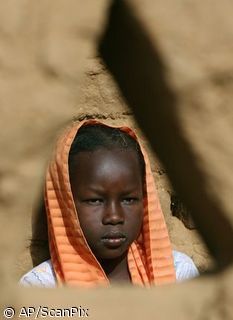 A baby girl loses her mother at birth. A few years later, she is “sold” into domestic labor by her own father.
more »
A baby girl loses her mother at birth. A few years later, she is “sold” into domestic labor by her own father.
more »
 Scarce and unevenly distributed rainfall has made water a key economic and social development issue in Morocco.
more »
Scarce and unevenly distributed rainfall has made water a key economic and social development issue in Morocco.
more »
 Rainfall in August and September 2009 confirmed the fears of serious risk of natural disasters in years to come resulting from rising sea levels, greater erosion of coastal zones, destruction of the mangroves, and devastating floods.
more »
Rainfall in August and September 2009 confirmed the fears of serious risk of natural disasters in years to come resulting from rising sea levels, greater erosion of coastal zones, destruction of the mangroves, and devastating floods.
more »
 Fifteen years after the groundbreaking Fourth World Conference on Women, which was held in Beijing in 1995, the international community has clear legal norms on the prohibition of discrimination and the active promotion of gender equality and women's empowerment.
more »
Fifteen years after the groundbreaking Fourth World Conference on Women, which was held in Beijing in 1995, the international community has clear legal norms on the prohibition of discrimination and the active promotion of gender equality and women's empowerment.
more »
 Ahead of International Women's Day, the European Commission strengthened and deepened its commitment to equality between women and men with a Women's Charter.
more »
Ahead of International Women's Day, the European Commission strengthened and deepened its commitment to equality between women and men with a Women's Charter.
more »
 The World Bank Institute has launched an online multiplayer game, EVOKE, designed to empower young people all over the world, but especially in Africa, to start solving urgent social problems like hunger, poverty, disease, conflict, climate change, sustainable energy, lack of health care and education.
more »
The World Bank Institute has launched an online multiplayer game, EVOKE, designed to empower young people all over the world, but especially in Africa, to start solving urgent social problems like hunger, poverty, disease, conflict, climate change, sustainable energy, lack of health care and education.
more »
 One of the crucial questions facing EU asylum policy is the extent to which countries share the demands of asylum seekers.
more »
One of the crucial questions facing EU asylum policy is the extent to which countries share the demands of asylum seekers.
more »
 Youth in three major universities explored what they can do to address climate change, something that experts in a knowledge-sharing forum in Silliman University in Dumaguete City say is already at Filipinos’ doorsteps.
more »
Youth in three major universities explored what they can do to address climate change, something that experts in a knowledge-sharing forum in Silliman University in Dumaguete City say is already at Filipinos’ doorsteps.
more »
 The Parliament needs to connect more with women voters as research shows them to be trapped in a vicious circle, being under-represented in the EP and EU politics in general and, therefore, less interested and less involved than men.
more »
The Parliament needs to connect more with women voters as research shows them to be trapped in a vicious circle, being under-represented in the EP and EU politics in general and, therefore, less interested and less involved than men.
more »
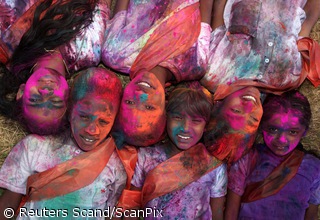 The streets of India became a kaleidoscope of colour, as locals celebrated Holi.
more »
The streets of India became a kaleidoscope of colour, as locals celebrated Holi.
more »