The words were strong and the emotions were high as an international congress in Vilnius claimed that communists killed 100 million people throughout the world and appealed to the United Nations and all democratic countries to create a special tribunal fo
Published:
25 June 2000 y., Sunday
Witnesses from Lithuania, Bulgaria, Hungary and other Central European countries spoke about their personal suffering from communist repression. Lithu-anian lawyer Vytautas Zabiela said that the process would have only moral, not legal consequences. Lech Walesa, the former
president of Poland and Nobel Peace Prize recipient, attended the congress held June 12-14. He received the Nobel Peace Prize for fighting against the communist regime when he was the leader of the Polish independent Solidarity trade unions.
"More people were killed in peace time than during two world wars in this part of the world," Walesa said about communist terror.
The congress participants, victims of communist repression, politicians, political scientists and lawyers from 23 countries, said that Vilnius is a symbolic place for such an anti-communist forum. Lithuania lost one-third of its population during Soviet occupation because of killings,
deportations and forced emigration, said Povilas Jakucionis, chairman of the Lithuanian Political Prisoners and De-portees Union. This union and three similar Lithuanian organizations of victims of communism organized the congress.
Copying, publishing, announcing any information from the News.lt portal without written permission of News.lt editorial office is prohibited.
The most popular articles
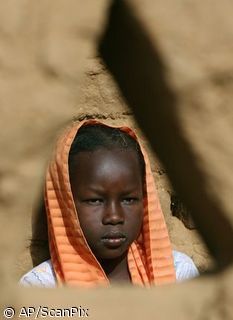 A baby girl loses her mother at birth. A few years later, she is “sold” into domestic labor by her own father.
more »
A baby girl loses her mother at birth. A few years later, she is “sold” into domestic labor by her own father.
more »
 Scarce and unevenly distributed rainfall has made water a key economic and social development issue in Morocco.
more »
Scarce and unevenly distributed rainfall has made water a key economic and social development issue in Morocco.
more »
 Rainfall in August and September 2009 confirmed the fears of serious risk of natural disasters in years to come resulting from rising sea levels, greater erosion of coastal zones, destruction of the mangroves, and devastating floods.
more »
Rainfall in August and September 2009 confirmed the fears of serious risk of natural disasters in years to come resulting from rising sea levels, greater erosion of coastal zones, destruction of the mangroves, and devastating floods.
more »
 Fifteen years after the groundbreaking Fourth World Conference on Women, which was held in Beijing in 1995, the international community has clear legal norms on the prohibition of discrimination and the active promotion of gender equality and women's empowerment.
more »
Fifteen years after the groundbreaking Fourth World Conference on Women, which was held in Beijing in 1995, the international community has clear legal norms on the prohibition of discrimination and the active promotion of gender equality and women's empowerment.
more »
 Ahead of International Women's Day, the European Commission strengthened and deepened its commitment to equality between women and men with a Women's Charter.
more »
Ahead of International Women's Day, the European Commission strengthened and deepened its commitment to equality between women and men with a Women's Charter.
more »
 The World Bank Institute has launched an online multiplayer game, EVOKE, designed to empower young people all over the world, but especially in Africa, to start solving urgent social problems like hunger, poverty, disease, conflict, climate change, sustainable energy, lack of health care and education.
more »
The World Bank Institute has launched an online multiplayer game, EVOKE, designed to empower young people all over the world, but especially in Africa, to start solving urgent social problems like hunger, poverty, disease, conflict, climate change, sustainable energy, lack of health care and education.
more »
 One of the crucial questions facing EU asylum policy is the extent to which countries share the demands of asylum seekers.
more »
One of the crucial questions facing EU asylum policy is the extent to which countries share the demands of asylum seekers.
more »
 Youth in three major universities explored what they can do to address climate change, something that experts in a knowledge-sharing forum in Silliman University in Dumaguete City say is already at Filipinos’ doorsteps.
more »
Youth in three major universities explored what they can do to address climate change, something that experts in a knowledge-sharing forum in Silliman University in Dumaguete City say is already at Filipinos’ doorsteps.
more »
 The Parliament needs to connect more with women voters as research shows them to be trapped in a vicious circle, being under-represented in the EP and EU politics in general and, therefore, less interested and less involved than men.
more »
The Parliament needs to connect more with women voters as research shows them to be trapped in a vicious circle, being under-represented in the EP and EU politics in general and, therefore, less interested and less involved than men.
more »
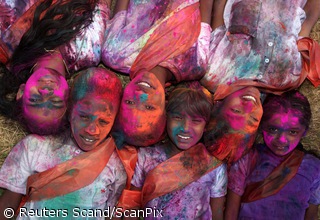 The streets of India became a kaleidoscope of colour, as locals celebrated Holi.
more »
The streets of India became a kaleidoscope of colour, as locals celebrated Holi.
more »